

Upflow → Blog → AR collections
Outstanding Invoice: Meaning & 5 Strategies to Collect Them
Quentin Gaudinat
|
July 3, 2026
Generate AI summary


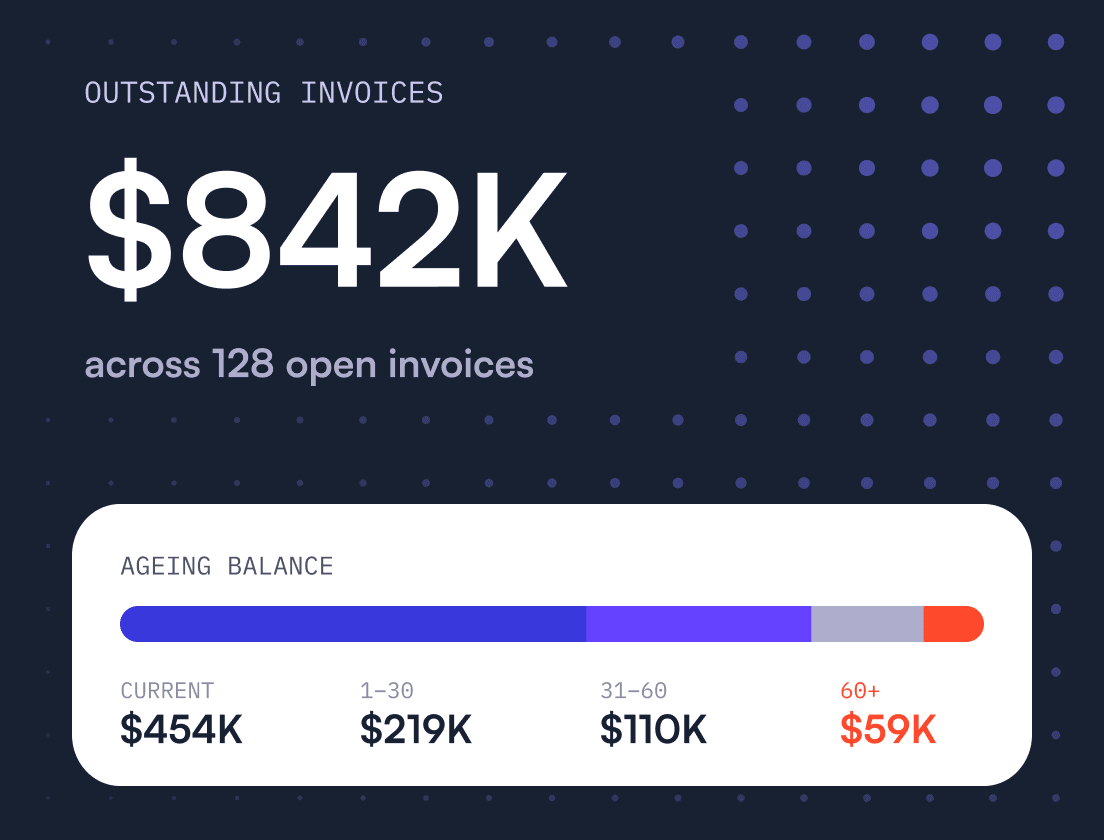
Outstanding invoices are a normal part of B2B business. An invoice goes out, payment is expected within 30, 60, or 90 days, and in most cases it arrives. But when it doesn’t, the gap between what’s owed and what’s in your bank account starts to matter.
The difference between finance teams that collect consistently and those that find themselves chasing the same accounts month after month usually comes down to process: how early they follow up, how systematic the escalation is, and whether their whole team is aligned on collections as a business priority. Keep reading to find out:
- What Does an Outstanding Invoice Mean?
- How to Collect and Reduce Outstanding Invoices: 5 Strategies
- How to Track and Manage Outstanding Invoices at Scale
- Steps to Writing Effective Payment Reminder Emails
Upflow integrates with your ERP, accounting or billing software to give your finance team real-time visibility into every outstanding invoice and automate follow-up from first reminder to final escalation.

What Does an Outstanding Invoice Mean?
An outstanding invoice is an unpaid bill that is still within the agreed payment period. It indicates that payment is due, but the deadline has not yet passed. These are amounts owed to a business for goods or services provided, and they are typically recorded in accounts receivable.
An outstanding invoice doesn’t seem like a problem at first. After all, your client may still pay before the invoice due date and it’s chasing an overdue invoice that costs you time and money.
But your invoices are 60% less likely to be paid once they pass that 90-day threshold. Thus you’re more likely to receive your money if you create a payment strategy targeting clients while invoices are still outstanding, rather than wait for late invoices.
What’s the difference between outstanding invoices and overdue invoices?
The terms outstanding and overdue are often used interchangeably when describing the payment status of an invoice. But the two words are not synonyms and the difference is more than a semantic issue.
- When an invoice is outstanding it means your client has not paid for a service but they are yet to cross the deadline to do so.
- When an invoice is overdue it means your client has not respected their payments terms and paid for a service. The deadline to do so has now passed. This is also known as a past due invoice.
Are your outstanding payments piling up? Have a look at our free guide with 8 tips to get paid on time!

How to Collect and Reduce Outstanding Invoices: 5 Strategies
1. Build a personalized and systematic collection strategy
The goal of your collection strategy is to minimize payments after the payment date. It also means implementing efficient processes so you no longer waste time on manual tasks and time-consuming manual payment reminders.
First, you must automate your redundant processes to enable you to focus on the most important part of the job: automating first email reminders will for example allow you to concentrate on risky accounts.
Then, you should set up different types of collection strategies depending on the types of accounts, how much they owe you, and how late they are.
Indeed, you shouldn’t send the same payment requests to “bad payers” (customers who often pay late) compared to your major accounts. In the former case, you should send a reminder before the invoice is late. As for larger accounts, you should make sure to highly personalize your reminders and start for example with a friendly call.
Regardless of how you segment your clients, you should guarantee that everyone has a consolidated view of all their invoices to avoid confusion about what’s owed and when.
Instead of sending individual reminders for every outstanding invoice, you should only send one reminder which totals all money owed. That way your clients aren’t bombarded with multiple messages about payment due dates.
2. Ensure that your whole team understands their role in the AR process
For the AR process to run smoothly you need the cooperation of your whole client-facing team – especially sales and customer success.
As explained at the beginning of the article, cash is the lifeblood of your company and there’s no point selling your product if you don’t get paid promptly for it. Most businesses don’t include their sales team in their AR strategy because they wrongly assume the task is the sole responsibility of the finance team.
But if you’re still struggling to get paid after a third reminder then your sales team may be the key to understanding why. You may think your client simply has poor management over their finances, but your sales team may be aware of an underlying issue. This could be an unresolved customer dispute or another problem your client has with your product or service.
You could have the perfect collection strategy in place. But there will still be obstacles to getting paid that can only be resolved by your business team. At Upflow for example, our sales team is responsible for the first invoice issued to a new client: that makes them involved directly in the process.
3. Provide an exceptional customer experience
Once you’ve automated redundant collection tasks, you should dedicate the time you’ve gained to building relationships with customers as part of your CX program
You can use a pre-written reminder template to ease your work but you shouldn’t forget that all customers are different. Personalize your message based on the size or type of account, the role of the recipient, and how late the invoice is.
Offering flexible payment methods will better your customer experience, and it’s the best way to help your customer pay you. Avoid a payment process gateway that is complex to set up or involves fees. Offering different payment options like credit cards or ACH is always a good idea.
You can also offer early payment discounts or payment plans if you suspect your client is struggling with cash flow problems. This allows them to make timely payments they can afford, and revenue will be more predictive for your business.
4. Design a contingency plan for unpaid invoices
You should be proactive with your invoice reminders and flexible with payment methods. But even with the right process in place, some customers will not pay. Having a contingency plan before you reach that point means you are not making decisions under pressure when an invoice hits 90 days.
Your contingency plan should cover a few things. First, whether late fees apply and at what point they kick in. Second, whether you will offer a payment plan to customers who are genuinely struggling with cash flow, since structured partial payments recover more than a collections referral in most cases. Third, at what threshold you escalate to formal action and who owns that decision internally.
The earlier these decisions are made, the easier it is to apply them consistently across accounts without the conversation becoming personal.
5. Final steps
- Call your clients: Some client-facing businesses like restaurants or retail are simply bad at dealing with their emails. A phone call to issue a friendly reminder is often enough to clear your outstanding invoice.
- Follow up with a letter: Outline every correspondence so far, from the original invoice through to your call. Your letter should clearly state the invoice number, the amount of the invoice, and the payment methods available right now.
- Use a collection agency or take legal action: This will likely sour your relationship with your client and debt collectors can charge fees as high as 50% of the amount due. This is your final course of action and should only be used when all other options have been exhausted.
How to Track and Manage Outstanding Invoices at Scale
Keeping track of outstanding invoices when you have a handful of customers is straightforward. A spreadsheet works. Someone remembers to follow up. But once you’re managing dozens of accounts with invoices at different stages, different payment terms, and different histories, the spreadsheet breaks down fast.
The first thing you need is a clear view of your AR aging report, which segments outstanding invoices by how close they are to becoming overdue: current, 1 to 30 days past due, 31 to 60, and so on. For outstanding invoices specifically, what matters is the current bucket: invoices that are due soon and haven’t been paid yet. These are the accounts where proactive action is still possible.
Most finance teams only look at their aging report after invoices have already gone overdue. That’s too late. The teams that collect most consistently review outstanding invoices before the due date and send a proactive reminder while the invoice is still current. One well-timed email before a deadline is more effective than three chasers after it.
At volume, this requires tooling. Upflow’s AR analytics give finance teams a real-time view of every outstanding invoice, sorted by customer, amount, and days until due. It flags accounts approaching their deadline automatically and runs the reminder sequence without manual input once configured. For companies sending invoices from Stripe Billing, Chargebee, Zuora or other invoicing software, invoice data syncs directly via integration. The same applies to ERP systems including NetSuite, QuickBooks, and Sage Intacct.
The result is a collections process where outstanding invoices get followed up consistently, overdue ones get escalated at the right time, and nothing slips through because someone forgot to check a spreadsheet.
Steps to Writing Effective Payment Reminder Emails
You’ve devised an amazing collection strategy that incorporates your whole team. But ultimately, your customers only see the end product of that strategy which are most often email reminders – and that’s why you can’t get this part wrong.
There are two aspects you need to consider:
- The quantity and timing of your emails
- The content of your emails
Both are important. And knowing when, how often and what to write depends on your client’s payment behavior and account size. Let’s dive deep into them.

A good reminder email increases the likelihood of being paid
When writing your templates, assume the recipient will read as little as possible. That’s not a criticism; it’s just how email works. Build your collection email strategy around that reality.
Subject line:
- Write it last, not first
- Keep it under 50 characters: short subject lines result in a 12% higher open rate
- Make it clear what the reader needs to do
- Example: {your company name}: ${balance due} overdue for {client name}
Opening:
- Limit your opening paragraph to 11 words maximum
- Short sentences are easier to read and more likely to keep the recipient engaged
Main body:
- State clearly what is owed and how the client can pay
- Use numbered bullet points if you have multiple invoices or figures to reference
- Keep each bullet to one sentence: long bullet lists are no easier to read than long paragraphs
- If there is a lot to cover, recommend a call instead
- For more templates and examples, see this article
Sign off with a CTA:
- Tell the client exactly how to pay before closing the email
- With Upflow, you can send clients a link to their customer portal where they can view all outstanding invoices and pay instantly with one click
- The easier it is to pay, the more likely you are to get paid

Quentin Gaudinat
Global Sales Director at Upflow
About the Author
Quentin is the Global Sales Director at Upflow, where he helps SaaS companies transform their revenue operations and improve cash flow performance. With hands-on experience advising hundreds of B2B finance teams, Quentin understands what it takes to build scalable financial processes in high-growth environments.
At Upflow, Quentin bridges the gap between sales and finance by enabling businesses to adopt smarter AR practices that accelerate collections and reduce friction in customer relationships. His work centers on helping SaaS leaders leverage automation and data for better financial outcomes.
On the Upflow blog, Quentin shares actionable insights for SaaS operators navigating the evolving finance and tech landscape. He writes about tools, trends, and strategies that help companies choose the right systems, streamline operations, and scale sustainably.
Summary

Shared
Frequently Asked Questions
Can’t find what you’re looking for?
Ask AI
An outstanding invoice is one that has been issued but not yet paid, where the payment deadline has not yet passed. An overdue invoice is one where the payment deadline has passed and the customer has not paid. In practice, every overdue invoice was once outstanding. The distinction matters because your collection strategy should differ: outstanding invoices benefit from proactive reminders sent before the due date, while overdue invoices require a more structured escalation process.
The terms are often used interchangeably, but there is a subtle distinction. An outstanding invoice typically refers to an invoice that is due but not yet past its deadline. An unpaid invoice is a broader term that can refer to any invoice that has not been settled, whether it is still within payment terms or significantly overdue. In accounting and AR management, outstanding invoices appear in accounts receivable as amounts expected to be collected, while unpaid invoices that remain unresolved may eventually be written off as bad debt.
No. Outstanding means a payment is due but the deadline has not yet passed. Overdue means the deadline has passed without payment. Outstanding is a neutral status: the invoice is in your accounts receivable and payment is expected. Overdue is when the problem starts and follow-up action is required.
An invoice is outstanding from the moment it is issued until it is either paid or becomes overdue. The length of time depends on your agreed payment terms. Standard B2B payment terms are net 30, net 60, or net 90 days, meaning an invoice can be outstanding for up to 30, 60, or 90 days before it becomes overdue. The key is to have a proactive collection process in place while invoices are still outstanding, so follow-up starts before the deadline passes rather than after.
The most effective approach is to start follow-up before the invoice becomes overdue. Send a proactive reminder a few days before the due date, then move to a structured escalation sequence if payment is not received: email reminders, phone calls, account manager involvement, and formal letters for significantly overdue balances. Segmenting your accounts by size and payment history helps prioritise effort. AR automation software like Upflow lets finance teams build these escalation workflows once and run them automatically, so every outstanding invoice gets consistent follow-up without manual tracking across hundreds of accounts.
The most effective tools combine real-time AR visibility with automated follow-up. Upflow gives finance teams a live view of every outstanding invoice segmented by customer, amount, and days until due, alongside overdue accounts ranked by risk. It automates payment reminders at each stage of the collection sequence and flags accounts approaching the overdue threshold so your team can act before invoices become a problem. Upflow integrates with Stripe Billing, Chargebee, and Zuora, as well as ERP systems including NetSuite, QuickBooks, and Sage Intacct.
Three things make the biggest difference: clear payment terms set upfront, proactive reminders sent before the due date, and a systematic escalation process for accounts that go overdue. Making it easy for customers to pay by offering multiple payment methods and a clear payment portal also reduces friction significantly. For finance teams managing high volumes, accounts receivable automation removes the manual tracking burden and ensures every account gets followed up consistently, which is where most outstanding invoices slip through without the right tooling in place.
Related articles