

Finance CRM Software
Financial Relationship Management Software for B2B Finance Teams
Most finance teams manage invoices. The best ones manage the relationships behind them. Upflow is finance CRM software built around that distinction, giving your team the context, workflow and AI agents to collect faster without treating customers like line items.
Trusted by the world's leading B2B finance teams














Most finance teams manage invoices. The best manage customer relationships.
A traditional CRM tracks sales relationships. Finance CRM software tracks the financial relationship: who owes what, what they have paid before, how they prefer to communicate, and what your team knows about them from every prior interaction. The criteria for evaluating it are different from a sales tool.

Customer-Level Context, Not Just Invoice Status
Look for software that gives your team a full picture of each customer: payment history, communication log, outstanding balances, and any disputes or notes from prior interactions. An AR specialist working from invoice status alone is missing half the information that determines how a conversation should go.

Segmentation and Workflow Personalisation
Not every customer should get the same outreach. Look for software that lets you segment by payment behavior, account type, risk profile, or invoice age and apply different workflows to each segment. A customer who always pays at 45 days needs a different approach than one who went silent after a dispute.

Intelligent Collections Workflows
Look for software where collections workflows adapt to what your team actually knows about each customer. Sending the same reminder template to every account, on the same schedule, regardless of history, is the fastest way to get ignored by your customers. The strongest FRM platforms now add AI agents that answer customer replies, log promises to pay and flag disputes, with your team deciding how much each agent does on its own.
Multi-Channel Communication
Your customers do not all prefer email. Look for software that supports outreach across email, SMS, calls, letters, and customer portal messages, with a clear record of every touchpoint in one place so your team is never flying blind on what was said and when.
ERP and Accounting Integration
Finance CRM software should connect directly to your ERP so invoice data, payments, and credit notes sync automatically in both directions, and to your sales CRM so account owners see payment status where they already work. A tool that requires manual data exports is not a CRM. It is another spreadsheet with a better interface.
Payment Experience for Your Customers
The collections side of a financial relationship is only half the picture. Look for software that includes a self-service payment portal where customers can view outstanding invoices, raise disputes, and pay by card or direct debit, in full or in part, without having to email your team. When settling an invoice is that straightforward, it stops feeling like a chore and starts reflecting well on your brand.
How Finance CRM Software Like Upflow Works
From invoice to paid, with the customer relationship intact throughout.
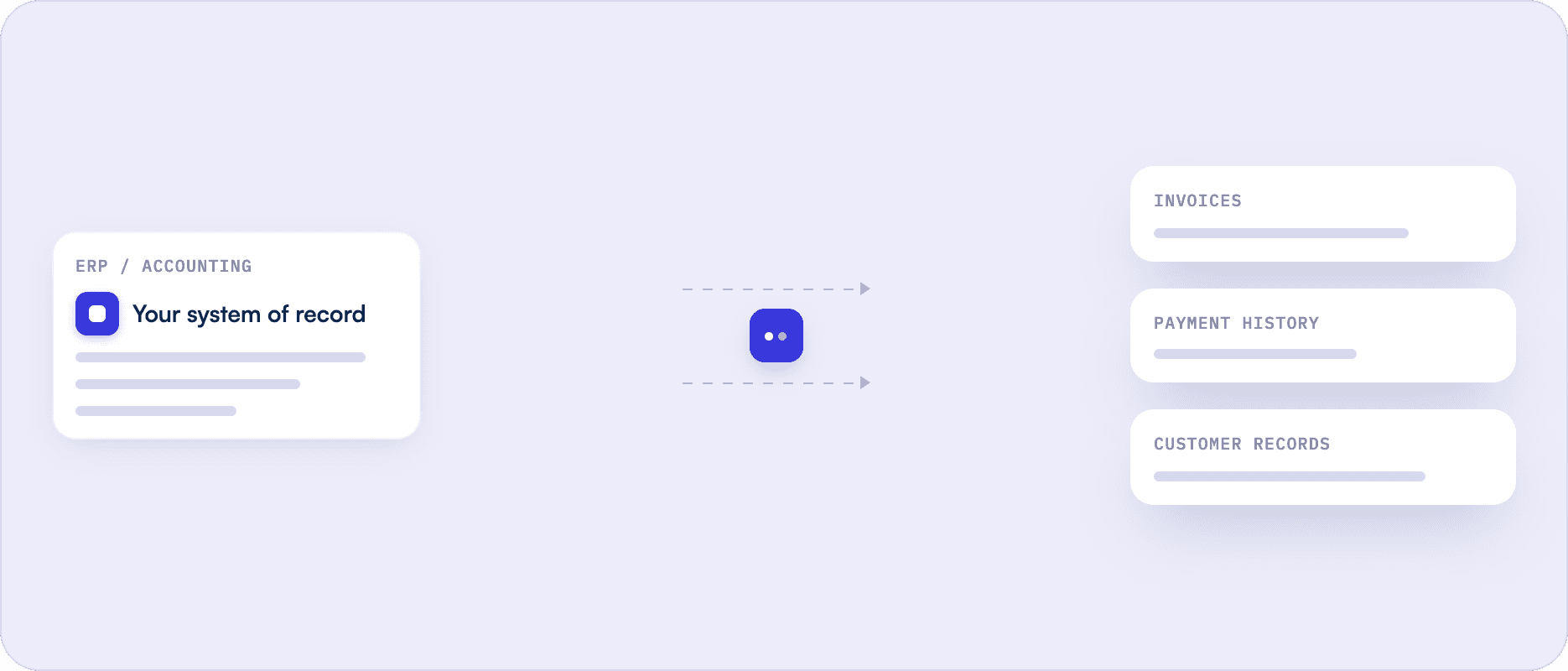
Sync Your ERP and Customer Data
Upflow connects to your ERP and pulls in invoices, payment history, credit notes, and customer records automatically, and links to Salesforce or HubSpot so account owners and contacts come across too. From day one, your team has a complete financial picture of every customer account without building or maintaining it manually.
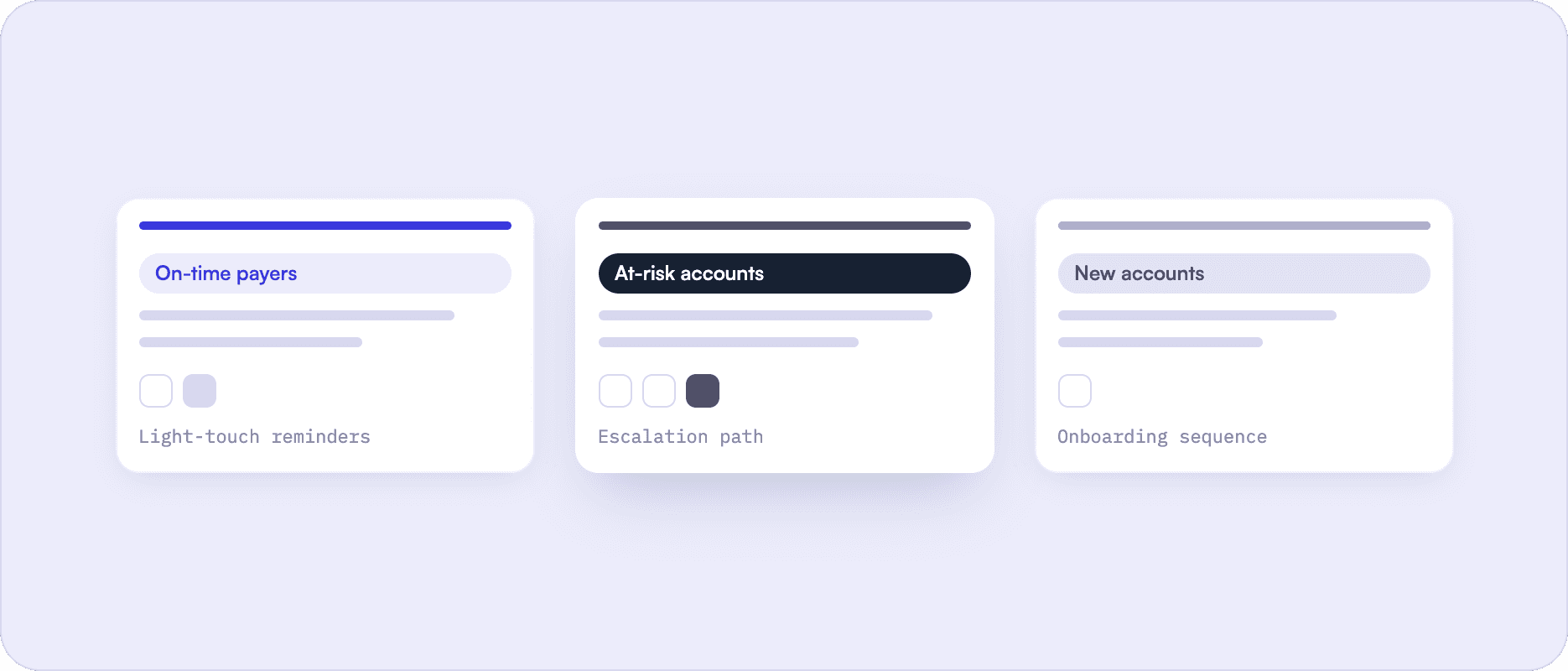
Segment Your Portfolio
Divide your customer base by payment behavior, account type, risk profile, or any combination that fits how your team thinks. Every customer also gets an A to D rating based on their average payment delay. Each segment gets its own workflow, outreach timing, and escalation path so your collections process reflects what you actually know about each customer rather than applying a single approach to everyone.
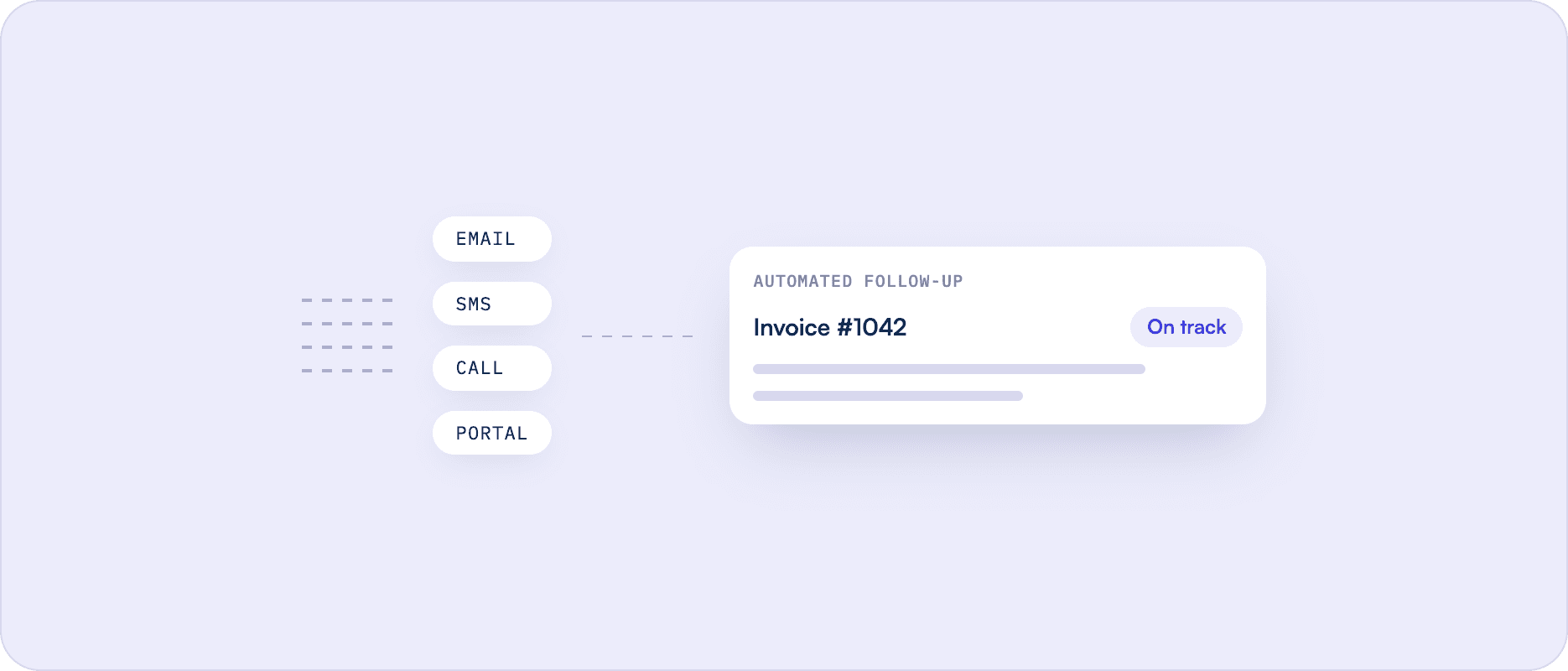
Automate Outreach and Follow-Up
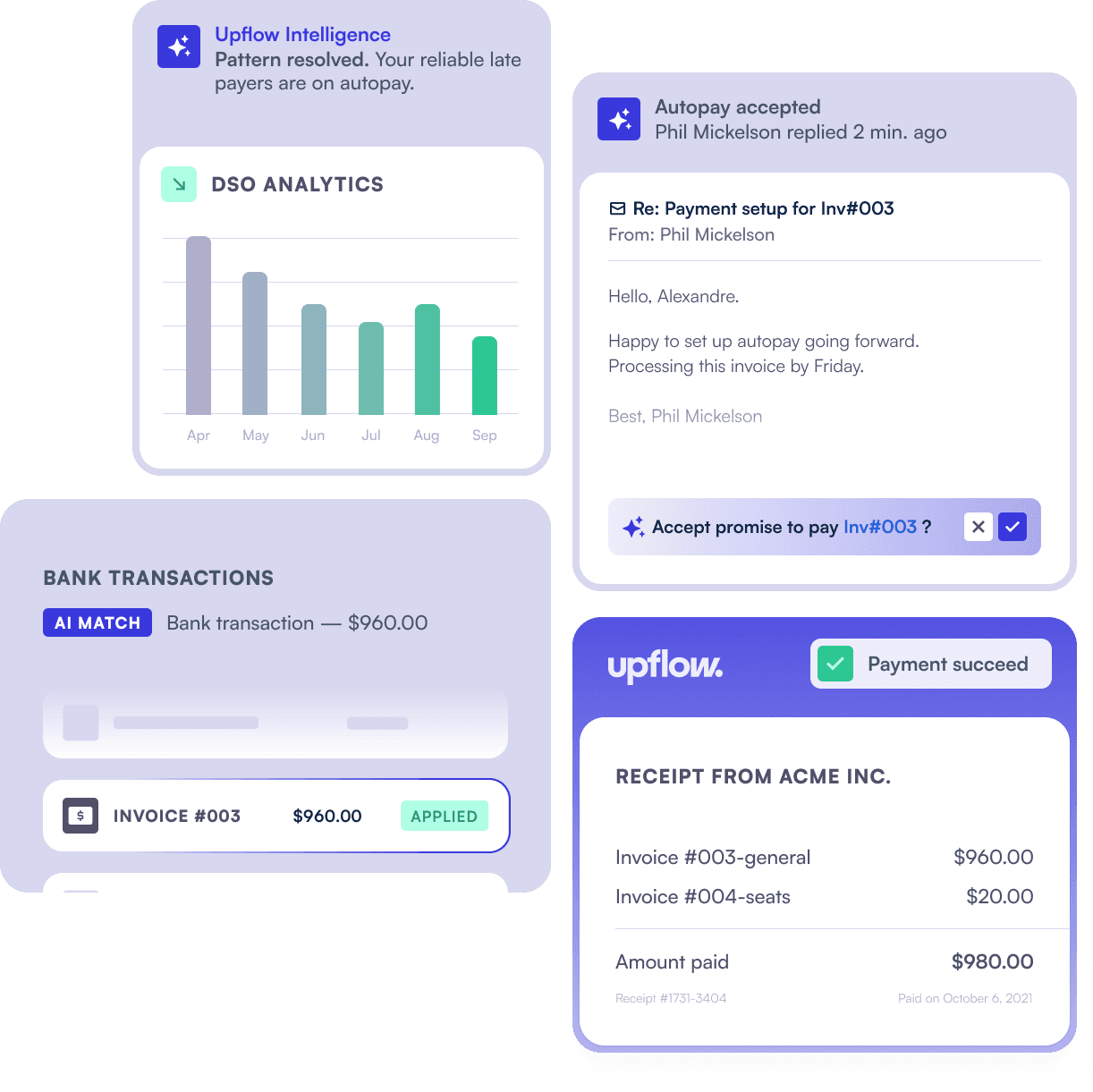
Set up reminder sequences across email, calls, SMS, letters and customer portal messages. Upflow handles the routine follow-up on each segment automatically, and when customers reply, the Collections Agent can answer, log promises to pay and flag disputes, as suggestions or on its own for the skills you choose. Your team’s time goes to the accounts that need a judgment call, not the ones that just need a nudge.
Work the Exceptions With Full Context
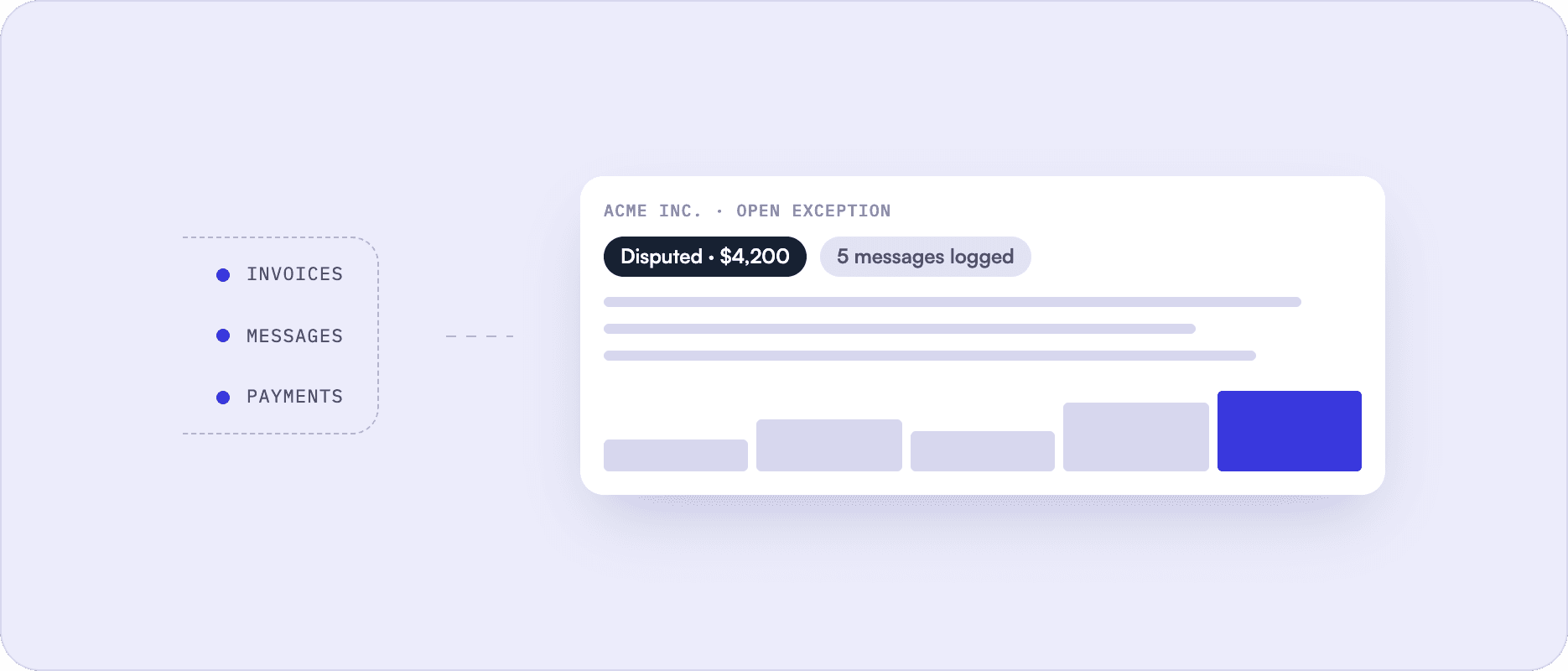
When an account needs your team’s attention, everything they need is in one place: the invoice history, the communication log, the customer’s payment patterns, and any open disputes. Your team can also ask Upflow in plain language what is happening on an account. No switching between systems to piece together what happened.
Give Customers a Clean Way to Pay
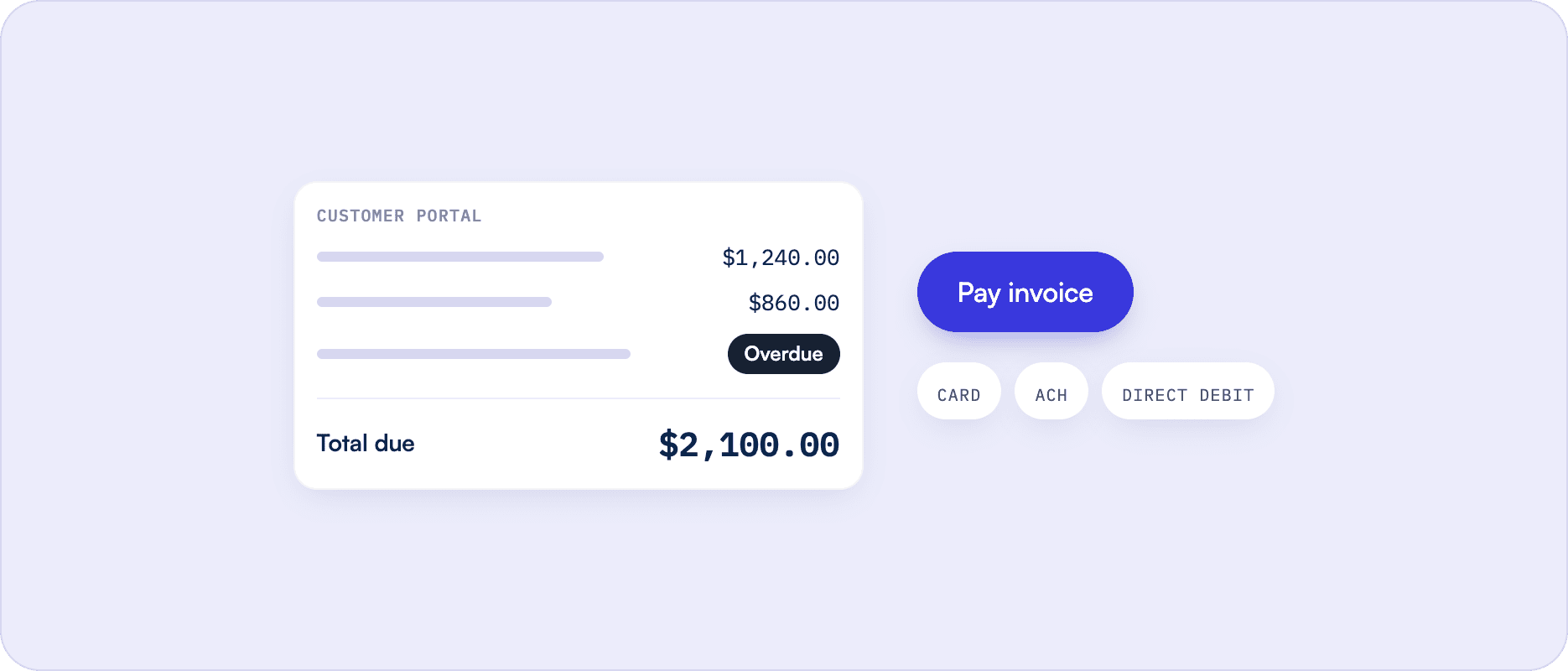
Upflow’s customer portal lets your customers view outstanding invoices, ask questions, and pay by card, ACH, SEPA or BACS direct debit, in full or in part. A frictionless payment experience reduces disputes and gets invoices closed faster.
Upflow Finance CRM Software (3 Core Capabilities)
The tools your finance team needs to collect faster and protect the relationships that matter.
Collections Workflows and AI Agents
Upflow’s agents handle the volume: they reply to customer emails, log promises to pay, flag disputes and apply clear payment matches. You decide, skill by skill, whether an agent only suggests or acts on its own, and anything it isn’t confident about comes back to your team.
Analytics and AR Reporting
Track DSO, Collection Effectiveness Index, and overdue balances in real time. Know which customers are drifting and act before a late payment becomes a write-off. Your finance team gets the visibility to manage the portfolio, not just react to it.
Customer Portal and Modern Payments
Give your customers a self-service portal where they can view invoices, raise disputes, and pay by card or direct debit, with Autopay for recurring invoices. A clean payment experience reduces friction, speeds up collection, and protects the relationship your sales team worked to build.
Finance CRM Software That Connects to Your Existing Stack


 NetSuite
 Pennylane
 QuickBooks Online
 Rillet
 Sage Intacct
 Xero
 Chargebee
 Stripe Billing
 Zuora
 Gmail
 Slack
 MCP Server (Claude, ChatGPT, Copilot)
 Professionnal Services
 Upflow APIHubspot
 Salesforce

Billing
CommunicationGmailSlack
GmailSlackCRMHubspotSalesforce
HubspotSalesforceAdvanced Custom Integrations
Accounting & ERP
Plug into your ERP, billing, and CRM systems in minutes. Fast setup, reliable sync, ongoing support.

Real-time sync
No-code setup
Enterprise-grade security
Don't see your tool?
Don't see your tool?
Benefits of Using Finance CRM Software Like Upflow
Get paid faster without the customer relationship taking the hit.
Collect Faster
Automated workflows and AI agents handle routine follow-up across your entire portfolio. Your team focuses on the accounts that need a real conversation, not on sending the same reminder to 200 customers manually.
Stop Managing Invoices, Start Managing Relationships
Traditional AR tools track what is owed. Upflow tracks the customer behind the invoice: their payment history, communication preferences, and the context your team has built up over months of interactions. That context is what separates a collection tool from an FRM platform like Upflow.
Reduce DSO Without Damaging Relationships
Faster collections and better customer relationships are usually presented as a tradeoff. They are not. When your outreach is timed correctly, personalized to each account, and delivered through a payment experience that does not feel adversarial, customers pay faster because the process respects them, not because they are being pressured.
Give Customers a Payment Experience Worth Repeating
A customer who can view their invoices, ask a question, and pay in just a few clicks is far less likely to go silent on an overdue balance than one who received a PDF and a follow-up email two weeks later. The payment experience is part of the customer experience.
Keep Sales and Finance Aligned
When collections require a difficult conversation, it helps if finance and sales are working from the same information. Upflow’s Salesforce, HubSpot and Slack integrations keep both teams in sync so a collections escalation does not blindside a relationship your sales team is actively managing.
Scale What Your Best People Already Do
Your most experienced team members know which customers need a push, which need patience, and which are a write-off risk worth escalating. Upflow’s AI agents apply that kind of judgment consistently across your whole portfolio, within the limits your team sets, not just on the accounts your best person happens to be working that week.
4.8/5 average rating
from 230+ reviews on G2





Finance CRM Software FAQs
Everything You Need to Know About Finance CRM Software
Ask AI


Finance CRM software, also called financial relationship management (FRM) software, manages the financial relationship between a B2B vendor and its customers. Unlike a traditional CRM, which tracks sales and marketing interactions, finance CRM software tracks payment history, invoice status, collections communications, and customer behavior across the order-to-cash cycle. The goal is to give finance teams the same kind of customer context that sales teams have, so they can collect effectively without damaging the relationships the business depends on.
Financial Relationship Management (FRM) is a category Upflow pioneered to describe the financial layer of the customer relationship. A CRM manages the sales and success relationship. FRM manages the finance relationship through three tenets: context (the full picture of how each customer pays and communicates), coordination (keeping finance, sales and the customer aligned throughout the payment cycle), and trust (making the experience of paying an invoice feel professional, not adversarial). FRM treats every invoice as a customer touchpoint, not just a transaction to be closed. Most B2B companies run both side by side: the CRM for pipeline and renewals, FRM for invoices, payments and collections, with AR status syncing into the CRM so both teams see the same account.
Traditional AR automation tools focus on efficiency: sending reminders faster, reducing manual steps, cutting DSO. That is necessary but not sufficient. Upflow’s approach adds the relationship layer: customer segmentation, personalized workflows, a clean payment experience, and AI agents that apply your team’s judgment across your whole portfolio rather than sending the same sequence to every account. The goal is to collect faster while keeping the customer relationship intact.
Yes. Upflow connects directly to your ERP and accounting tools (NetSuite, Sage Intacct, QuickBooks, Xero, Pennylane), billing platforms (Stripe Billing, Chargebee, Zuora), and the tools your team uses day to day (Salesforce, HubSpot, Gmail, Slack), with an open API for custom integrations. Invoice data, payments, and credit notes sync automatically so your team always works from current data. Salesforce and HubSpot users see each customer’s AR status and payment portal link without leaving their CRM, which keeps sales and finance aligned on the same accounts.
Upflow surfaces accounts that go off pattern: customers who have stopped responding, invoices approaching a risk threshold, or disputes that have been open too long. When a customer does reply, the Collections Agent can flag a dispute or log a promise to pay straight from their email. Your team gets a prioritized view of what needs attention, with the full communication history and payment context in one place. No investigation required, the information is already there.
Many small businesses start by tracking receivables in their sales CRM or accounting tool, which works until follow-up becomes a weekly job. Upflow is built for B2B companies where the financial relationship with customers is complex enough to manage actively: multiple invoices per customer, recurring billing, accounts that require different outreach strategies, or portfolios where a single overdue balance can affect the broader relationship. If your billing is simple and your customers pay reliably, a basic invoicing tool may be enough. If managing who owes what, when to follow up, and how to do it without damaging the relationship is a real part of your team’s work, Upflow is built around that problem.
Pricing varies by vendor. Some tools charge per user, others by invoice volume or revenue. Upflow prices plans by invoiced revenue with no seat fees, so finance, sales and customer success can all work in it without adding cost. Upflow Discover is a free plan that shows your DSO, Best Possible DSO and other AR metrics from your live data, so you can evaluate before committing.
The main alternatives are purpose-built AR platforms with relationship management features, like Upflow, or trying to adapt a general-purpose CRM like Salesforce or HubSpot to track payment interactions. The problem with the latter is that a sales CRM is not built around invoice data, payment cycles, or collections workflows. You can configure it to track some of this, but you are always working against the grain of a tool designed for a different job. An FRM platform also covers what a CRM cannot, like cash application, a customer payment portal and cash forecasting based on your receivables.
Upflow is a financial relationship management platform built with AI agents at its core. The Collections Agent handles inbound customer emails: it replies, logs promises to pay, flags disputes and captures remittance advice. The Cash App agent applies bank transactions to invoices when the match is unambiguous, and Ask Upflow answers questions about any customer or your whole portfolio in plain language. You set each agent skill to Off, Suggestions only or Auto-mode, so the relationship context FRM depends on stays under your team’s control. Every agent action appears on the customer timeline.
Yes. Upflow maintains an active SOC 2 Type II attestation covering the Security, Availability and Confidentiality criteria. Data is hosted by Amazon Web Services in the EU (Ireland), encrypted in transit with TLS 1.2 or better and at rest with AES-256 or better. Upflow uses continuous backups and database replication to protect against failures, and Cloudflare for DDoS mitigation.
Upflow connects to NetSuite, Sage Intacct, QuickBooks Online, Xero, Rillet and Pennylane for accounting data, Stripe Billing, Chargebee and Zuora for billing, Salesforce and HubSpot for CRM context, and Gmail, Outlook and Slack for customer emails and team alerts. A public API covers other systems, and an MCP server lets your team query live AR data from AI assistants like Claude or ChatGPT. Most connections take minutes, and most teams are fully live within a few days to a few weeks.
Full AR visibility, free forever.
Get AR analytics with your live data, benchmarked against best-in-class B2B companies.