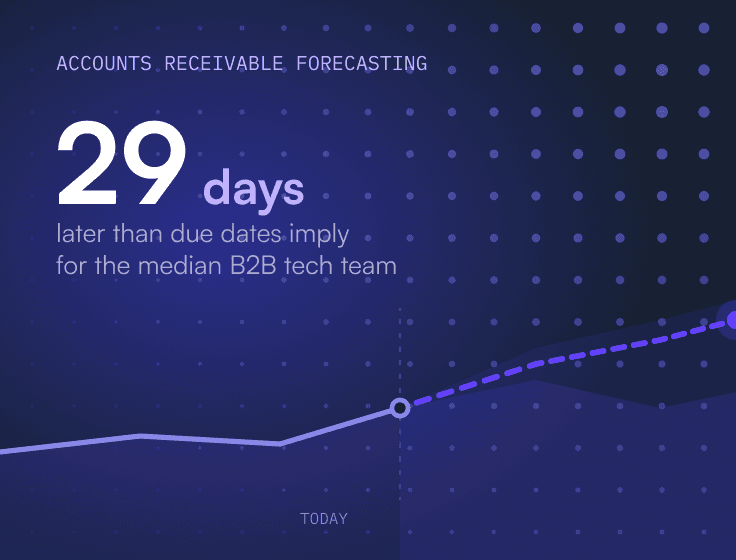


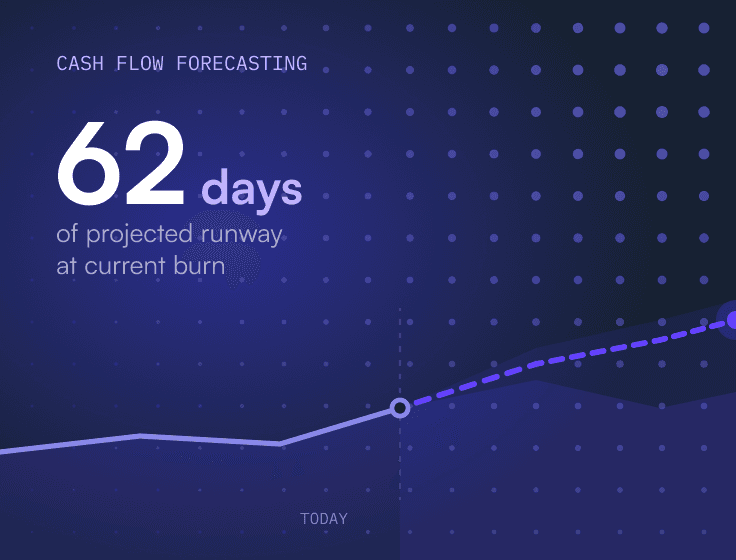
Cash flow forecasting sounds straightforward on paper. You project what comes in, what goes out, and what you are left with. The complexity shows up when customers pay later than expected, invoices pile up in aging, and the numbers you built the forecast on stop matching reality.
Getting the outflow side right is rarely the problem. Payroll, rent, and software costs are predictable. Where most forecasts lose accuracy is on inflows, specifically in how you estimate when customers will actually pay. In this guide, you will learn:
- What is Cash Flow Forecasting?
- Cash Flow Forecast vs Projection vs Statement
- Cash Flow Forecasting Methods
- Short-term vs Long-term Cash Flow Forecasting
- How to Create a Cash Flow Forecast Step by Step
- Cash Flow Forecast Template and Example
- How to Improve Cash Flow Forecast Accuracy
Connect your ERP or accounting tool in just a few clicks and see your billing cohort collection rates and cash forecast instantly.

What is Cash Flow Forecasting?
Cash flow forecasting is the process of estimating how much cash will move in and out of your business over a future period. The output is a projected cash position, updated regularly as actuals come in and new information changes the picture.
For B2B companies, the honest version of that definition includes a caveat: your outflows are largely knowable in advance, but your inflows are not. Payroll dates, rent, and software renewals are all predictable. But inflows depend on when customers actually pay, which is shaped by your billing cycle, your payment terms, your collections process, and each customer’s own cash situation. None of that is fully in your control, and very little of it is predictable from the invoice due date alone.
That gap between expected and actual collections is where cash flow forecasting gets hard, and where most of the useful work happens.
Cash Flow Forecast vs Projection vs Statement
These three terms appear interchangeably in finance conversations. They mean different things, and mixing them up creates real confusion about what a given number is actually telling you.
A cash flow forecast covers the short to medium term, typically 13 weeks to 12 months. Finance teams update it regularly and use it for operational decisions: whether there is enough runway to make a new hire, whether a credit line needs to be drawn, whether a slow collections month will create a problem before the quarter ends.
A cash flow projection covers a longer horizon, usually one to five years. It is used for strategic planning, fundraising, and board reporting. The further out it goes, the more it depends on assumptions about revenue growth and market conditions rather than observable payment data. Projections are useful for direction, but not for operational decisions like managing next month’s cash position.
A cash flow statement is historical. It records how cash actually moved through the business during a completed period and sits alongside the income statement and balance sheet as one of the three core financial statements.
The table below shows the key differences across time horizon, purpose, accuracy, and primary use case.
| Cash flow forecast | Cash flow projection | Cash flow statement | |
|---|---|---|---|
| TIME HORIZON | 13 weeks to 12 months | 1 to 5 years | Historical period (Past quarter, year, etc.) |
| PRIMARY PURPOSE | Operational liquidity management (Day-to-day and near-term decisions) | Strategic planning and fundraising (Board reporting, investor decks) | Financial reporting and analysis (One of three core financial statements) |
| ACCURACY | Moderate to high (Higher for near-term, lower further out) | Directional only (Based on growth assumptions) | Exact record (Actual transactions, not estimates) |
| MAIN AUDIENCE | CFOs and finance teams | Boards and investors | All stakeholders |
Cash Flow Forecasting Methods
There is no single right way to build a cash flow forecast. The approach depends on your time horizon, the data available, and the level of precision you actually need. Two methods cover most use cases.
Direct Method
The direct method tracks actual cash transactions. Money received from customers, money paid to suppliers, payroll, tax payments. Rather than adjusting net income or working backwards from accounting profit, it looks at what hits the bank account and when.
This makes it the more accurate method for short-term forecasting. If you know which invoices are outstanding and have data on how quickly different customer segments actually pay, you can build a reasonably tight 30 to 60-day view. The limitation is that you need transaction-level data to do it properly. For companies with high invoice volumes or complex billing structures, assembling that data manually is time-consuming.
The direct method works best for forecasts of 13 weeks or less, and for companies that need precise near-term cash visibility rather than a directional view.
Indirect Method
The indirect method starts from net income and adjusts for non-cash items, like depreciation and amortisation, and working capital movements, like changes in accounts receivable and payable. It is the same logic used in the operating section of a formal cash flow statement.
It is faster to build than the direct method because it draws on existing financial reports rather than individual transactions. The tradeoff is precision. You get a directional view of cash generation, not a week-by-week picture of what is landing in your account and when.
Most B2B finance teams end up using both methods. Direct for the next 13 weeks where week-level accuracy matters. Indirect for the quarter and year ahead where directional accuracy is sufficient. Trying to force one method to do both jobs usually means it does neither well.
Short-term vs Long-term Cash Flow Forecasting
The time horizon you choose shapes everything about how you build the forecast and what you can reasonably expect from it. Short-term and long-term forecasts serve different purposes and require different approaches.
Short-term: The 13-Week Cash Flow Forecast
The 13-week cash flow forecast is the standard for operational cash management. Thirteen weeks is long enough to catch problems before they become urgent and short enough that most inputs are known rather than estimated. Lenders and restructuring advisors typically ask for it when they want to understand near-term liquidity, so it is worth having one ready before you need it.
Finance teams at B2B companies typically run a 13-week forecast on a rolling basis, updating it weekly as new invoices are issued and payments come in. The rolling structure matters. A static 13-week forecast built in January and not touched until March has stopped being a forecast by February.
The thing that separates a useful 13-week forecast from an optimistic one is how collections are handled. An invoice marked as due does not become cash on that date if the customer routinely pays later than agreed. Building on due dates rather than actual collection patterns means your projected cash position is overstated for weeks on every invoice. At scale, that gap becomes material.
Medium-term: 3 to 12 Months
At this horizon you are working with less certainty on individual transactions and more with patterns. Expected revenue, seasonal cash cycles, planned headcount, loan repayments due. The indirect method suits this range well.
This is the horizon that matters most for board reporting, budget planning, and decisions about whether to raise capital before a constraint appears rather than during one. The numbers will not be precise, and they should not be presented as though they are. The value is in identifying which periods look structurally tight before they arrive.
Long-term: 1 to 5 Years
Long-term projections are strategic tools, not operational ones. At five years out, the cash figures are driven by your business model assumptions more than your current receivables position. They are useful for fundraising and scenario planning, but not for operational decisions like whether to extend a supplier payment this week.
There is a tendency to dress up long-term projections as forecasts by adding granular line items. That granularity is false precision. A 60-month cash model is making assumptions about revenue growth, pricing, headcount, and market conditions that no one can predict with accuracy. Build it honestly, present it as a projection, and do not use it to make operational decisions.
How to Create a Cash Flow Forecast Step by Step
Building a cash flow forecast is less about finding the right template and more about making honest assumptions at each step. The process below works for most B2B finance teams, whether you are building your first forecast or improving one that already exists.
Step 1: Choose your time horizon and method
If you are building a short-term operational forecast, use the direct method and work at the weekly level. If you are building a medium-term planning forecast, use the indirect method at the monthly level. The time horizon determines the method, and the method determines what data you need. Getting this wrong at the start means rebuilding later.
Step 2: Map your outflows first
Start with outflows because they are easier to know. Fixed costs, payroll, rent, software, and loan repayments are predictable. Variable costs require more judgment but are still more controllable than inflows.
List every outflow by expected payment date, not invoice received date. A supplier invoice received on March 15 with net-30 terms is a March entry on your profit and loss statement but an April cash outflow. Getting this wrong creates a false cushion in your forecast that disappears when the payment actually goes out.
Step 3: Build your inflow estimate from actual collection data
This is where most forecasts go wrong, and where the difference between a useful forecast and an optimistic document gets made.
The easy approach is to take outstanding invoices, assume customers pay on their stated terms, and book the cash accordingly. If you have $300,000 in invoices due this month on net-30 terms, you book $300,000 in inflows this month. The problem is that stated terms and actual payment behaviour are different things. If your days sales outstanding is running at 51 days on net-30 terms, forecasting inflows on 30-day assumptions means you are overstating cash position by three weeks on every invoice in the book.
Use your actual collection history instead. Look at your accounts receivable data and your billing cohorts: what percentage of invoices issued in previous months collected in month one, month two, month three? Use those rates as your inflow assumptions. If your last six months averaged 76% collection in month one, that is your inflow rate for month one, not 100%.
Your AR aging report is a useful starting point for understanding where your receivables actually sit, and how different customer segments behave.
Step 4: Calculate net cash position by period
Subtract total outflows from total inflows for each week or month and add the result to your opening cash balance.
Opening cash balance + Cash inflows – Cash outflows = Closing cash balance
Run this across each period in your forecast window. The pattern matters as much as any individual number. A closing balance that declines steadily across eight consecutive weeks is a different problem from one that dips in week four and recovers by week seven.
Step 5: Stress test your inflow assumptions
Run a scenario where your three largest customers each pay 30 days later than your baseline assumptions. If that scenario brings your cash balance below one month of operating expenses, you have a concentration risk the baseline forecast is not surfacing. This scenario is uncomfortable to run, which is usually a sign it is overdue.
Also stress test the collection rate. If your baseline assumes 76% first-month collection, run it at 62%. See what the closing balance looks like. If the result puts you below a comfortable cash buffer, that is worth addressing in your collections process before it becomes a real scenario.
Step 6: Update it on a regular cadence
A forecast built once and left alone is a document, not a tool. The value comes from updating it regularly, comparing actuals to forecast each period, and understanding specifically where and why gaps occurred. A 13-week forecast updated weekly with a standing 20-minute variance review will improve meaningfully over two months as you learn where your inflow assumptions are consistently off and by how much.
Cash Flow Forecast Template and Example
The structure of a cash flow forecast is consistent across most businesses. What varies is the data that goes into it, particularly in the inflow rows. The template below covers the standard layout, followed by a worked example using a real B2B SaaS scenario.
Cash Flow Forecast Template
A standard cash flow forecast template captures inflows and outflows by period, calculates net cash movement for each period, and tracks the running cash balance. The image below shows the structure for a monthly forecast that works for most B2B companies.
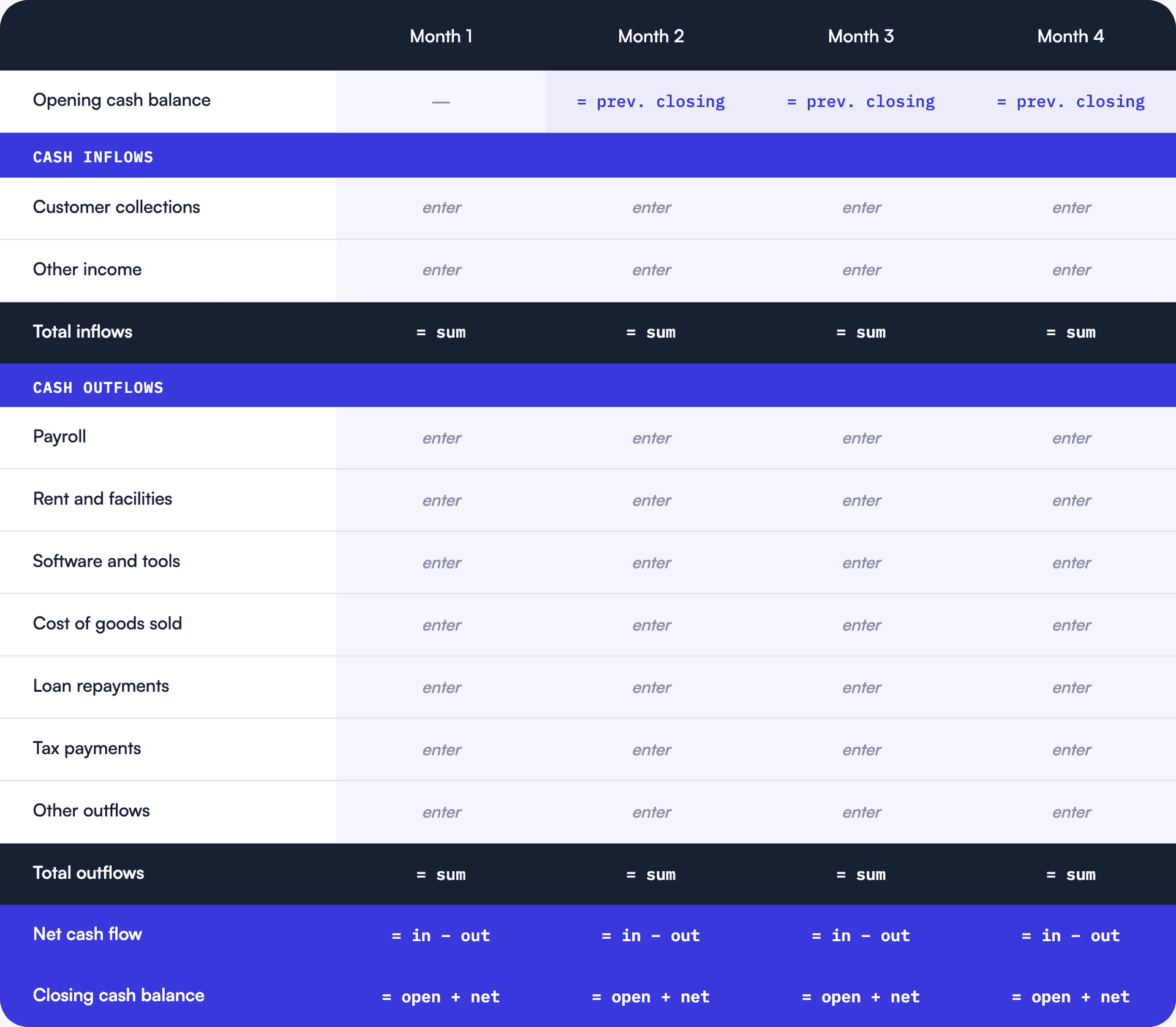
The template structure is the simple part. The work is in the customer collections row, where the accuracy of your inflow assumptions determines how useful the whole thing is. The numbers in that row should come from your collection history, not from your payment terms.
Cash Flow Forecasting Example
The table below is a cash flow forecast example for NorthStack, a B2B SaaS company with $4.2M ARR, 180 active customers, and net-30 payment terms. The forecast covers Q1 2026. All figures in USD thousands.
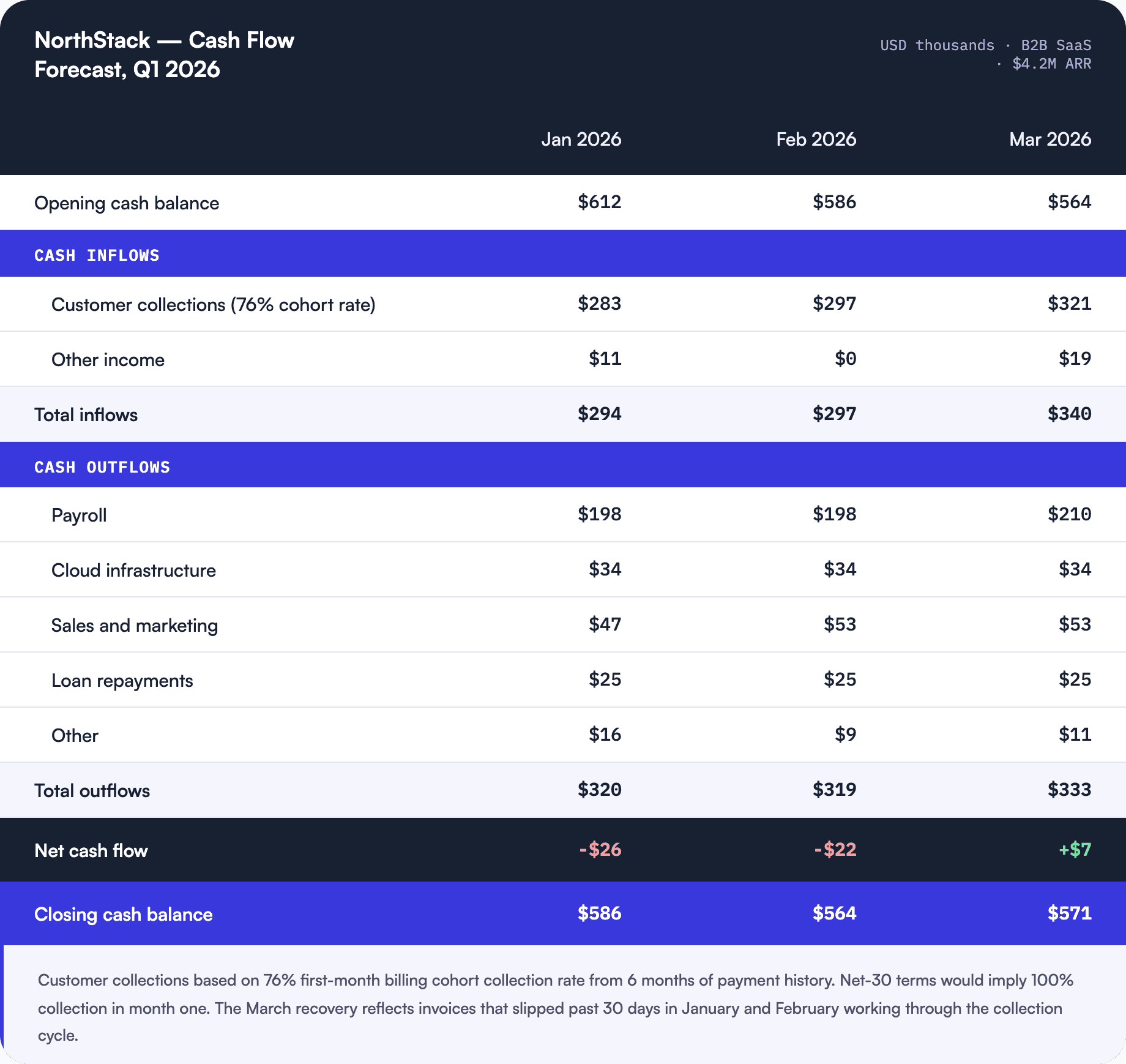
NorthStack runs cash-flow negative in January and February, which is common for B2B SaaS companies investing ahead of collections. The customer collections figures use a 76% first-month collection rate from billing cohort data, not the 100% implied by net-30 terms. March turns modestly positive as invoices that slipped past 30 days in January and February work their way through the collection cycle.
The closing balance of $571K at end of March is $41K below the January opening, which is not a crisis but is a direction worth monitoring. If February collections come in at 63% instead of 76%, the February closing balance falls to around $528K and the March recovery needs to carry more weight than the baseline assumptions. That scenario is not unlikely if two or three mid-size accounts slip. Knowing that in January rather than in late February is the value of building the forecast from cohort rates rather than due dates.
How to Improve Cash Flow Forecast Accuracy
Most advice on improving forecast accuracy focuses on process changes. The usual advice is to update more frequently, build more scenarios, and use better cash flow forecast software. That advice is not wrong, but it has a ceiling. At some point, the limiting factor is not how you run the process. It is the quality of the data going into the inflow side of the model.
The problem with using DSO for inflow forecasting
Most finance teams use DSO to estimate when customer payments will arrive. It is the metric they track, it is on the metrics they track on their financial dashboards, and it feels like the natural input for collection timing. The problem is that DSO is an average, and averages are the wrong unit for forecasting timing.
If your DSO is 45 days, that tells you the mean collection time across all invoices in a given period. It tells you nothing about the invoice currently sitting at day 47 with no payment and no response to the last reminder. You cannot project when cash will arrive from a mean when the variance in individual invoice collection is what actually determines your cash position week to week.
Billing cohorts replace a single average with a distribution. Instead of “customers pay in 45 days on average,” you know that 79% of last month’s invoices collected in month one, 14% collected in month two, and 6% were still outstanding at month three. You can build an inflow forecast from those rates. You cannot build a reliable one from a DSO figure.
This is not a minor refinement. A forecast built on DSO is structurally optimistic because it assumes every invoice behaves like the average invoice. A forecast built on cohort collection rates reflects the actual distribution of payment timing, including the invoices that will take twice as long as the average and the ones that will not collect at all.
Upflow calculates your billing cohort collection rates automatically by connecting in real-time with your ERP or accounting tool. The cash forecast widget inside the platform uses those rates to project inflows forward without requiring any manual modelling.
See how Upflow builds cash forecasts from your actual receivables data rather than payment term assumptions.

Use rolling forecasts, not static ones
A static annual forecast built in January is largely disconnected from reality by April. Rolling forecasts extend the window forward each period and update based on actuals, which keeps the model anchored to current conditions rather than January assumptions.
The discipline of comparing actuals to forecast each period also surfaces patterns that would otherwise stay invisible. If your collections consistently come in below forecast in the third week of each month, that tells you something specific about your billing cycle or customer payment behaviour that you can investigate and act on.
Reduce DSO to narrow your uncertainty window
The longer your average collection period, the wider the uncertainty band in your inflow forecast. A business collecting faster can project inflows with reasonable confidence two to three weeks out. A business collecting in 65 days is guessing about six weeks of cash position, which makes the near-term forecast significantly less reliable.
Reducing DSO improves forecast accuracy as a direct consequence of shortening the uncertainty window.
Segment inflows by customer
Treating all customers as a single pool in your forecast hides concentration risk. If your five largest customers represent 38% of revenue and three of them have a history of paying at 55 to 65 days on net-30 terms, your aggregate collection rate looks acceptable while the specific problem stays buried.
Build your inflow forecast with at least two segments: customers who pay reliably within terms, and those who do not. The second group needs a more conservative collection assumption and a different collections workflow. Tracking accounts receivable metrics at the customer level makes this segmentation practical rather than theoretical.
Catch late payments before they compound
Forecast accuracy also depends on catching collection problems early enough to act on them. An invoice seven days past due is a reminder. An invoice 45 days past due is a cash position problem that is already affecting your current period forecast.
An accounts receivable software closes the gap between those two states by triggering systematic follow-up at the right intervals without relying on a team member to manually track every open invoice. Tighter collections produce less variance between forecast and actual, which makes each subsequent forecast more reliable.

Alexandre Antoine
Finance Director at Upflow
Alexandre is the Finance Director at Upflow, where he leads the company’s internal finance and accounting operations. With a background in both strategic finance and financial reporting, Alexandre brings a practical, detail-oriented approach to the complexities of B2B finance.
At Upflow, Alexandre ensures that internal processes from cash management to KPI reporting are optimized for transparency, accuracy, and growth-readiness. He helps build scalable finance systems that support Upflow’s mission to empower other finance teams through better collections and cash flow insights.
Alexandre regularly contributes to Upflow’s blog with in-depth articles on accounting metrics, financial ratios, reporting best practices, and operational benchmarks. His writing provides actionable advice for controllers, FP&A teams, and finance leaders navigating complex financial processes.

Summary

Shared
Frequently Asked Questions
Can’t find what you’re looking for?
Ask AI


A cash flow forecast is a forward-looking estimate of cash inflows and outflows over a specific future period. It projects your cash position based on expected customer collections, planned expenditures, and other known cash movements. Finance teams use it to anticipate shortfalls, manage liquidity, and make decisions about hiring, investment, and debt before problems arrive rather than after.
A cash flow forecast typically covers a shorter horizon, 13 weeks to 12 months, and is used for operational decisions. It is updated regularly as actuals come in. A cash flow projection covers a longer horizon, often one to five years, and is used for strategic planning and investor reporting. The further out you project, the more the numbers depend on growth assumptions rather than observable payment behaviour. Both are useful, but for different purposes.
A cash flow statement records how cash actually moved through the business during a past period. A cash flow forecast estimates how cash will move in a future period. One is a record, the other is an informed estimate. Finance teams use both: the statement to understand what happened, the forecast to prepare for what comes next.
The direct method tracks actual cash transactions and works best for short-term forecasts of 13 weeks or less where transaction-level data is available and near-term precision matters. The indirect method starts from net income and adjusts for non-cash items and working capital changes, and is more commonly used for medium to long-term forecasting where directional accuracy is sufficient. Most B2B finance teams use both depending on the time horizon.
Short-term 13-week forecasts should be updated weekly. Medium-term forecasts covering a quarter or full year are typically updated monthly. The cadence matters less than the discipline of comparing actuals to forecast each time and understanding specifically why variances occurred. That review process is what makes each subsequent forecast more accurate.
A 13-week cash flow forecast is a short-term, direct-method forecast covering the next three months on a week-by-week basis. It is the standard format for operational liquidity management because it is detailed enough to surface problems early and short enough that most inputs are knowable rather than guessed. It is also the format lenders and investors typically request when they want to understand a company’s near-term cash position.
Related articles