

Upflow → Blog → Financial Relationship Management
CRM vs FRM: Should Finance Teams Have Their Own CRM?
Alex Louisy
|
August 5, 2026
Generate AI summary


Most B2B finance teams have used a CRM at some point, even if it was not built for them. The sales team runs Salesforce, so finance logs a note there when a customer has an overdue invoice, or someone builds a spreadsheet that loosely functions as a contact tracker and works well enough until the invoice volume makes it unworkable.
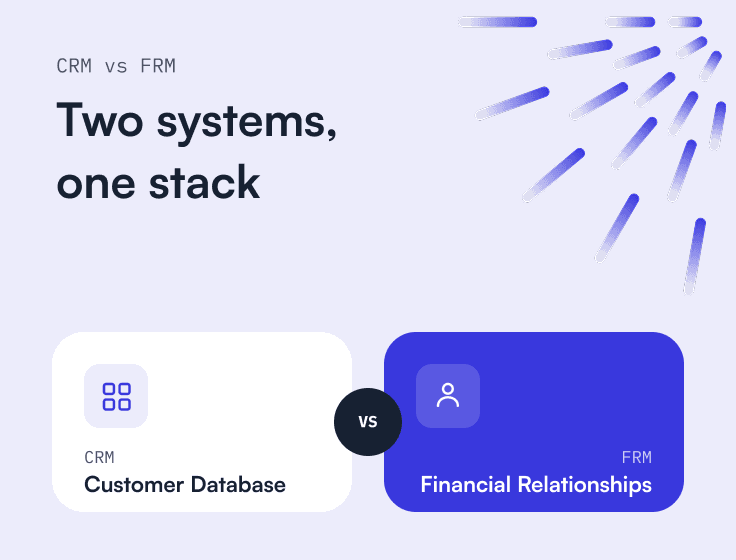
The problem is not that CRMs are bad tools. It is that they were built for a different job. A CRM tracks the commercial relationship between a company and its customers through the lens of sales and marketing, and it does not know anything about invoices, payment terms, or who in a customer’s organization actually approves payments. Financial Relationship Management, or FRM, is what happens when you apply the same relationship-first logic to the finance function specifically. It is not a replacement for CRM. It solves a different problem for a different team. In this guide, we’ll explore:
- What is a CRM, and what does it actually do?
- Where CRM falls short for finance teams
- What FRM actually does differently
- CRM vs FRM: the real differences
- The Agentic AI layer: where FRM is heading
- What to look for in an FRM platform
Want to see how Upflow handles the financial relationship end to end? Book a call with one of our experts.

What is a CRM, and what does it actually do?
A CRM, Customer Relationship Management software, is built around the commercial relationship between a business and its customers. It centralizes contact data, tracks communications, manages pipeline stages, and gives sales and marketing teams a shared view of where each prospect or customer stands.
The most widely used platforms, Salesforce, HubSpot, Microsoft Dynamics, and Zoho, share a similar structure: contacts organized into accounts, accounts moving through pipeline stages, interactions logged against each record, and revenue forecasted from the aggregate. For sales teams this works well because all the data they need to do their job sits in one place, whether that is who they last spoke to, what was agreed, or what a deal is worth.
Finance teams operate on different data entirely. A CRM will tell you that a customer signed a contract worth $120,000. It will not tell you that their accounts payable team requires invoices to be submitted through a specific portal, that they routinely pay 15 days past terms, or that the contact who approves payments is not the same person who signed the contract. That information lives somewhere else, usually across email threads, ERP records, and institutional memory held by one or two people on the team.
What finance teams actually want when they look for a CRM
Finance teams looking for a CRM for collections or a CRM with dunning capabilities are rarely looking for Salesforce with a few extra fields. What they actually want is a clear view of each customer’s payment history and current outstanding balance, a way to track every communication tied to a payment or dispute, automated follow-up sequences that adjust based on how overdue an invoice is or how a customer has paid in the past, and visibility for the broader team so that collections conversations do not blindside a relationship that sales spent months building.
None of that is what a standard CRM is built to do. CRMs track the pre-sale and post-sale commercial relationship. They are not built around the payment relationship, which involves different stakeholders, different data, and different workflows. That gap is exactly what FRM addresses.
Where CRM falls short for finance teams
The reason finance teams reach for CRM tools in the first place is understandable. Managing collections well requires treating customers as relationships, not invoice numbers. CRM is the most familiar tool for managing relationships at scale, so it is the natural starting point.
The fit breaks down quickly in practice, and it tends to break in the same four places.
1. The data is never quite right: A CRM does not know your AR aging, which invoices are overdue, or by how much. Getting that information into a CRM requires either someone on the finance team entering it manually or a custom integration that needs to be scoped, built, and maintained indefinitely. Either way, the data is usually a step behind what is actually happening, which is exactly the kind of lag that costs you in collections.
2. The workflow structure does not fit: CRM automation is built around deal stages and marketing sequences, where contacts move through a funnel and the platform fires actions at each transition. Collections is built around invoice age, payment terms, and how a specific customer has behaved historically. These inputs do not map cleanly onto each other, and trying to force them together creates gaps that the team ends up filling manually with spreadsheets and calendar reminders.
3. Every customer gets treated the same: A CRM runs contacts through the same funnel logic regardless of who they are, because the sales use case it was designed for demands consistency at scale. Collections requires the opposite. A customer five days late on their first invoice needs a different response than a customer who has been with you for three years and is 30 days overdue for the second time this year. Standard CRM logic does not capture that distinction without significant custom development, and most finance teams do not have the resources or the appetite to build and maintain it.
4. Payment context lives somewhere else: When a finance team member opens a customer record in Salesforce, they see call notes and email history from the sales team, which tells them nothing about what actually matters for a collections conversation: whether the customer’s AP team changed recently, whether there was a disputed invoice last quarter, or whether this particular customer always pays on the 15th regardless of what the due date says. That context determines how to handle the outreach, and it lives entirely outside the CRM.
What FRM actually does differently
Financial Relationship Management applies the same relationship-first logic as CRM, but built specifically for the finance function. Where a CRM is organized around the sales pipeline, FRM is organized around the payment relationship: the ongoing series of interactions between a finance team and the finance contacts at each customer, across every invoice, reminder, dispute, and payment.
The starting point is a customer-level view of the financial relationship that goes beyond a list of open invoices. It includes the full history: how this customer pays, which contacts handle payments on their side, what communication has already happened, what disputes are open, and where things stand across every outstanding invoice. The kind of context that in most companies is spread across a spreadsheet, two inboxes, and someone’s memory.
On top of that, FRM platforms automate outreach in a way that accounts for the relationship. Not a generic reminder sent to every overdue account on day seven, but a sequence that adapts to the customer: their payment history, their account tier, the age of the invoice, and whether anything unusual is happening in this particular cycle. A long-standing customer who has always paid on time but is slightly late this month gets treated differently from a newer customer with no track record. That distinction matters for whether the customer relationship stays intact after the collections conversation.
FRM also creates cross-team visibility that CRM does not. When a collections touchpoint is scheduled to go out, sales and customer success can see it. If a customer is mid-negotiation on a renewal or has an open support escalation, finance knows before the reminder lands. That coordination is one of the concrete ways FRM improves customer retention alongside cash flow: collections becomes something the whole company is aware of, not an isolated process that occasionally creates friction at the wrong moment.
Beyond workflow, there is a trust dimension that pure automation misses. How a company manages its payment conversations is visible across finance, sales, and customer success. A collections process that feels transactional or poorly timed reflects on the business as a whole. FRM gives finance the tools to make that experience feel intentional, which matters for the long-term relationship with the customer.
Upflow’s native Salesforce integration makes this practical. Customer-level AR data from Upflow, including outstanding balances, overdue amounts, average payment delay, and collection status, syncs to Salesforce in near real-time. So when a sales rep opens an account in Salesforce, they can see exactly where that customer stands financially before reaching out, without needing to ask finance.
Finally, FRM connects payment data directly to the AR workflow. When a payment comes in, it matches to the right invoice and updates the customer’s status in the same system where the collections workflow lives. In a CRM setup, that reconciliation step happens elsewhere, usually in the ERP, and the two records drift apart. In an FRM platform, the payment closes the loop.
CRM vs FRM: the real differences
The clearest way to understand the gap is to look at what each tool is actually organized around.
A CRM is built for sales, marketing, and customer success teams. Its primary data is contacts, deals, and pipeline stages, and the relationship it tracks is the commercial one: how a prospect became a customer, how that customer engages with the product, and where the next commercial opportunity might be. Outreach is prospecting, nurturing, and support. Integrations connect to the marketing and sales stack. Customers are segmented by deal stage, industry, or revenue tier.
An FRM platform is built for finance and AR teams. Its primary data is invoices, payment history, and AR aging, and the relationship it tracks is the financial one: how a customer pays, who handles payments on their side, and the full history of every collections touchpoint. Outreach is payment reminders, dunning sequences, and dispute resolution. Integrations connect to ERP systems, accounting software, and bank feeds. Customers are segmented by payment behavior, invoice age, and account tier.
| CRM | FRM | |
|---|---|---|
| Built for | Sales, marketing, customer success | Finance, AR, collections |
| Primary data | Contacts, deals, pipeline stages | Invoices, payment history, AR aging |
| Relationship tracked | Prospecting, nurture, support | Payment reminders, dunning, dispute resolution |
| Key workflows | Lead management, deal tracking | Collections campaigns, cash application, reconciliation |
| Integration priority | Marketing tools, sales stack | ERP, accounting software, bank feeds |
| Who uses it daily | Sales reps, account managers | CFOs, Controllers, AR managers, collections teams |
| Payment visibility | None natively | Central to the platform |
| Customer segmentation | By deal stage, industry, revenue | By payment behavior, invoice age, account tier |
Neither tool does the other’s job well, and that is not a design failure on either side. A CRM has no native payment visibility because payments were never part of the workflow it was built to manage. An FRM platform has no pipeline management because deal stages are irrelevant to collections. The two are complementary, and companies that run both get the full picture of each customer rather than a commercial team and a finance team each working from a different version of it.
The connection matters, and Upflow’s Salesforce integration is the practical version of it. AR data from Upflow syncs to Salesforce in near real-time, so sales teams always have financial context on their accounts. An account executive can see that a customer has an overdue balance before sending a renewal email, and finance can flag an account’s collection status without anyone having to chase each other for an update.
The Agentic AI layer: where FRM is heading
The most significant shift in FRM right now is the role of AI agents in the collections workflow, and it is worth being precise about what that means in practice.
Every collections team builds up judgment over time. They learn which customers need a firm follow-up and which respond better to a lighter touch, when to push and when to wait, what it usually means when a customer who always pays on time goes quiet for two weeks. That judgment is genuinely valuable, and it took years to accumulate.
The problem is that it does not scale beyond a certain point. A team of three can apply it carefully across 50 accounts. At 300, coverage breaks down and the team ends up focusing on the accounts that shout loudest rather than the ones that most need attention. New customers get a generic first move because there is no prior history to draw on. And when someone on the team leaves, the institutional knowledge they built goes with them.
Upflow’s AI agents are built to address exactly that. For established customers, they learn the patterns the team already applies and execute them consistently across the full portfolio, covering the accounts that would otherwise fall through the cracks in a busy week. For new customers, they draw on what Upflow has seen across millions of real B2B collection interactions to make an informed first move rather than defaulting to something generic.
Upflow’s agents prioritize, draft, surface, and match. The team reviews and decides. The judgment stays with the people who built it, and what the agents provide is coverage and consistency at a scale that no team could achieve by hand.
This is also where FRM diverges most clearly from CRM, even as CRM tools add AI features. CRM AI is built around marketing sequences and sales cadences. FRM AI is built around the specific judgment calls that determine whether a B2B customer pays on time, pays late, or becomes a collections problem. Those require different training data and different logic, and tools designed for one cannot reliably do the other.
What to look for in an FRM platform
If your finance team is evaluating tools and the problem you are trying to solve is payment-related, a few things actually determine whether a platform will work in practice.
1. A genuine customer-level view of the financial relationship: The tool needs to show you every invoice, payment, reminder, and dispute for each customer in one place, not split across the ERP, an inbox, and a spreadsheet that one person on the team maintains. Without that consolidated view, the team is always working from an incomplete picture and making decisions accordingly.
2. Outreach that adapts to how a customer actually behaves: Collections sequences should account for who the customer is, how they have paid historically, and where things stand in the current cycle. A platform that fires the same reminder to every overdue account on the same day regardless of any of that context is just dunning with a nicer interface.
3. ERP integration that goes beyond a data sync: Most tools claim ERP integration, but the real question is whether it is live enough that the finance team can trust it as their system of record, with invoice data pulling in real time and payment status writing back automatically, rather than requiring someone to reconcile the two systems manually at month end.
4. Cross-team visibility that actually works: Sales and customer success need to see what finance is doing with a given account before a collections touchpoint goes out, and finance needs to know what is happening commercially with a customer before scheduling a reminder. Without that, both sides operate in silos and customers notice.
5. Cash application inside the same workflow: When a payment comes in, it should match to the right invoice and close in the same system where the collections workflow runs, not trigger a separate reconciliation in the ERP.
6. AI that scales judgment rather than replacing it: The right tool scales the judgment the team has built rather than trying to replace it, and gives the team full visibility into every decision the agents make and the reasoning behind it. Finance teams, particularly at companies where the finance function carries real strategic weight, need to be able to audit what the system is doing on their behalf.


Alex Louisy
Co-founder and CEO of Upflow
Alex is the Co-founder and CEO of Upflow, where he leads the company’s mission to revolutionize how B2B businesses manage their cash flow. Backed by top-tier investors like Hedosophia, YCombinator, Hexa, and Lorimer Ventures, with more than $25m in funding to date, he is a strong advocate for financial transparency and operational excellence, bringing a founder’s perspective to the biggest challenges and opportunities in modern revenue management.
Alex developed Upflow’s widely recognized “5 Maturity Stages of Cash Collection” framework, a model that has helped hundreds of companies build scalable and efficient finance operations. He also co-hosts The Growth-Minded CFO podcast, where he engages with finance and business leaders on innovative approaches to financial leadership. His thought leadership explores the intersection of business strategy, financial discipline, and organizational growth.
As a regular contributor to Upflow’s blog, Alex shares insights on leadership, scaling SaaS businesses, and the future of B2B finance. His writing helps founders, CFOs, and revenue leaders make smarter decisions and build financially resilient companies.


Frequently Asked Questions
Can’t find what you’re looking for?
Ask AI
A CRM (Customer Relationship Management) tool manages the commercial relationship between a business and its customers, built primarily for sales, marketing, and customer success teams. An FRM (Financial Relationship Management) platform manages the payment relationship between a finance team and its customers, covering collections workflows, payment reminders, cash application, and AR analytics. CRM tracks the pipeline. FRM tracks the invoice.
FRM software is a platform built specifically for finance and AR teams to manage the full payment relationship with their customers. It includes collections automation, dunning sequences, cash application, a customer payment portal, AR analytics, and ERP integration. The difference from CRM is that FRM is organized around invoices and payment behavior rather than deals and pipeline stages. Upflow is the leading FRM platform for B2B companies.
Not effectively. CRMs are not built around payment data, AR aging, or collections-specific workflows. Finance teams that try to run collections through a CRM typically end up maintaining parallel systems or filling gaps manually. FRM platforms are purpose-built for the finance use case in ways that general CRM tools are not.
Salesforce works well for sales and customer success teams. For finance teams managing collections, it requires significant customization to handle AR aging, invoice-level tracking, and collections workflows. Most finance teams find a purpose-built FRM platform more practical than trying to extend Salesforce into the collections use case. Upflow integrates directly with Salesforce so both teams can work in the tools they already use.
Finance teams looking for a tool to manage client payment relationships are typically better served by an FRM platform than a traditional CRM. Upflow is built specifically for this use case, covering collections workflows, payment reminders, cash application, and ERP integration in one platform. For teams that also need a general CRM, Salesforce and HubSpot both integrate with Upflow so the commercial and financial relationship stay connected.
FRM improves cash flow by making collections faster and more consistent. It protects customer relationships by making collections more personalized and less transactional. The two outcomes are connected: a payment reminder that reaches the right contact, acknowledges the customer’s history, and fits the context of the relationship is more likely to result in payment and less likely to create friction. That is the core logic behind FRM.
In finance, relationship management refers to how a company manages its ongoing interactions with customers around payments, invoicing, and financial communication. Unlike sales relationship management, which focuses on acquisition and expansion, financial relationship management focuses on the payment experience: reaching the right contact at the right time in a way that reflects the history and health of the relationship.
Yes. Upflow integrates directly with Salesforce, giving sales teams visibility into customer payment status without leaving their CRM, and giving finance teams commercial context before sending a collections touchpoint. The two platforms work alongside each other.
Related articles