

The 5 Best Cash Application Software for 2026
Jean-Malo Le Dreff
|
June 20, 2026
When a payment lands in your bank account, someone still has to figure out which invoice it covers, which customer sent it, and whether the amount matches what was owed. For teams processing dozens of payments a week, that’s manageable. For teams processing hundreds, it quietly becomes one of the bigger operational headaches in finance: reconciliation slips, AR aging goes stale, and before long your collections team is chasing customers who already paid.
That last one is the costly part. It wastes time and, more importantly, it damages relationships that took months to build.
That’s what cash application software is built to solve. But not all of it solves the problem the same way.
Most tools focus on higher match rates: push automation as far as it’ll go, and let your team deal with whatever falls through the cracks. That works until it doesn’t. When the automation is wrong and nobody catches it, the damage to collections accuracy and customer trust can be significant.
The real question is not how much you can automate, but how accurate the matching is, and what happens when it isn’t certain. That distinction is what separates tools built around volume from tools built around trust.
What to look for in cash application software
Before evaluating specific platforms, it helps to know what actually matters:
- Matching accuracy: Can it reliably match payments to the right invoice, even with partial payments, remittance gaps, or payer name mismatches?
- Exception handling: When the match isn’t clear, does it flag it cleanly for your team, or bury it?
- ERP write-back: Does it post reconciled transactions automatically, or does that require another manual step?
- Bank connectivity: How does it pull payment data? Direct bank feed, file upload, or both?
- Integration depth: Does it plug into your existing AR stack, or does it sit in a silo?
- Collections impact: Does reconciliation status feed directly into your collections workflows, so your team always knows who’s actually still outstanding?
- Audit trail: Can you see what was matched, when, and by whom, including what was applied automatically versus manually?
- Implementation timeline: Some tools take months to configure. Others are up and running in days.
The last point matters more than most vendors admit. A tool that requires six months of implementation and dedicated IT resources is not the same as one your finance team can configure themselves.
So, how do today’s top cash application tools line up?
1. Upflow
Best for: B2B finance teams that want accurate, trustworthy cash application connected directly to their collections workflows
Good fit for: Mid-sized and scaling companies (typically $10M-$500M revenue) that need cash application to feed directly into AR and collections, not sit in a separate tool
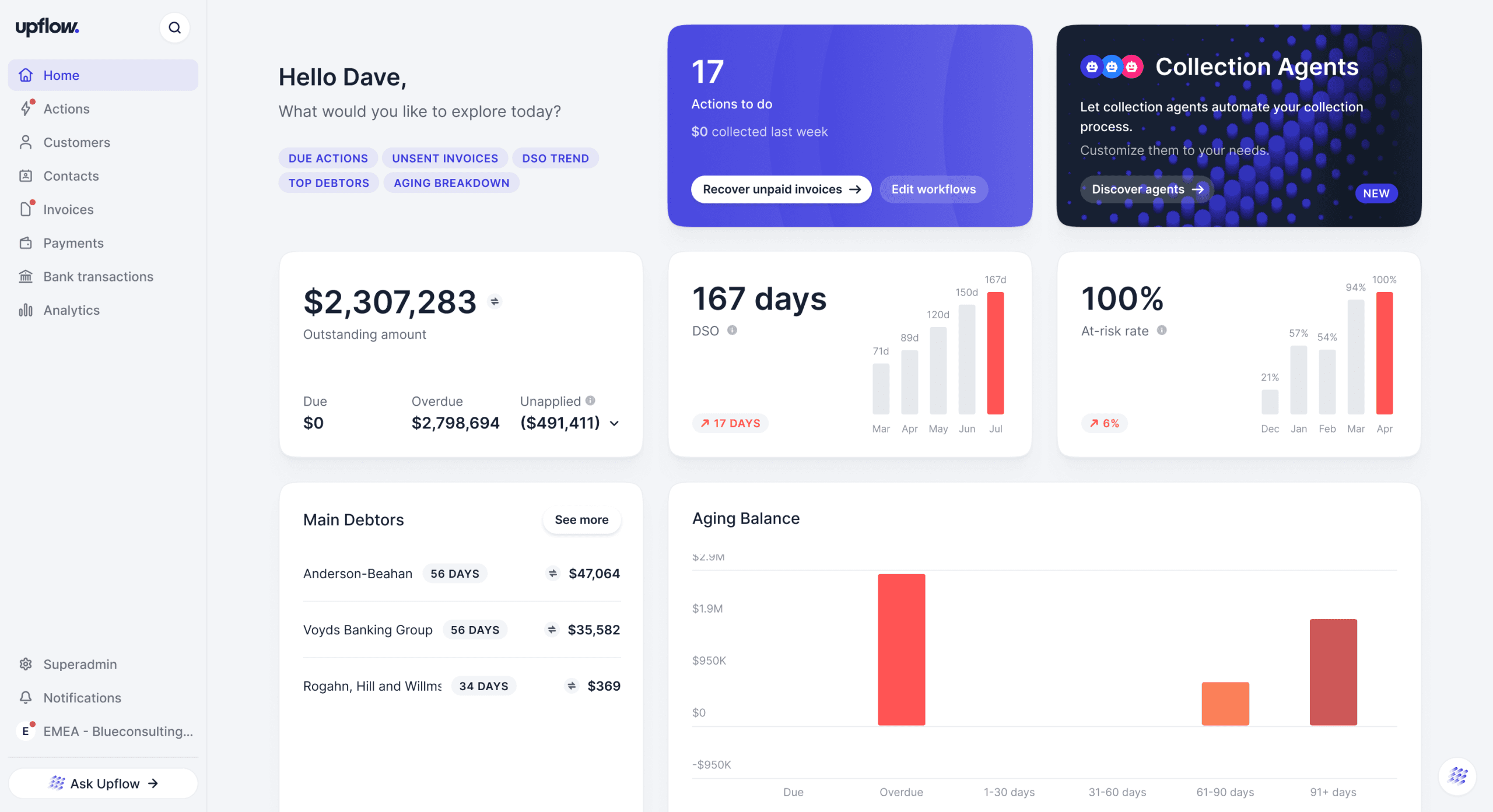
Upflow is the best cash application software for B2B companies because it is the only platform that treats reconciliation as part of the collections process, not a separate back-office task. Where most tools stop at matching payments to invoices, Upflow connects that reconciliation data directly into your accounts receivable management workflows, so your collections team always knows who has paid, who hasn’t, and who should never have been chased in the first place.
The core philosophy behind Upflow’s Cash App Agent is accuracy over automation. Its cash matching is conservative by design: it only auto-applies a transaction when the match is unambiguous. If there is any doubt, the transaction surfaces as a suggestion for your team to review. Tools that claim a 99% match rate are optimizing for a different goal. Upflow is optimizing for accuracy: every transaction the agent applies automatically is one your team would have approved anyway. That is not a limitation. It is a deliberate design choice built around what actually goes wrong when reconciliation gets it wrong.
Chasing a customer who already paid is one of the most damaging things a collections team can do. It wastes time, creates friction, and signals to the customer that your finance operation doesn’t have a clear picture of what’s happening. Upflow’s exception handling exists specifically to prevent that. Unmatched transactions are flagged clearly, with smart suggestions to help your team resolve them fast, not buried in a queue that nobody looks at.
Cash application in Upflow is also part of a broader system. It sits within Upflow’s Financial Relationship Management platform, so the moment a payment is applied, it is reflected in your AR aging and your team’s outreach queue. You are not reconciling in one tool and then manually updating another.
Key highlights:
- Conservative AI matching: auto-applies only when the match is unambiguous, flags everything else for review
- Smart suggestions for exceptions, so your team resolves them fast rather than starting from scratch
- Automatic ERP write-back once a transaction is matched, with NetSuite memo tagging for auto-applied payments
- Direct bank feed connectivity, pulling payment and remittance data from all sources automatically
- Full audit trail with distinct statuses for auto-applied vs. manually applied transactions
- Reconciliation data feeds directly into AR aging and collections workflows
- Shared visibility across finance, sales, and customer success so the right team member can be looped in or assigned when an exception needs context beyond reconciliation
- Part of Upflow’s broader FRM platform, connecting reconciliation directly to collections visibility
Consider if: You are a B2B finance team that needs cash application to be accurate enough to trust, and connected directly to your collections workflows rather than managed in a separate tool.
Keep in mind: Upflow’s cash application works best as part of the broader platform. Teams looking for a standalone reconciliation module without the AR layer will not get the full benefit.
2. Serrala

Best for: Large enterprises with SAP environments that need structured, high-volume payment processing.
Good fit for: Enterprise finance teams with dedicated IT resources and the runway for a multi-month implementation.
Serrala is a long-established player in enterprise finance automation, covering AR, AP, payments, and treasury in a single platform. Its cash application module is built for large organizations running SAP, with deep SAP-native integration and the option to deploy cloud, hybrid, or fully SAP-embedded depending on the company’s infrastructure.
The main consideration is complexity. Serrala is designed for organizations with serious implementation capacity: dedicated IT teams, SAP consulting partners, and the patience for multi-month rollouts. The platform’s strength is its depth, but that depth has a cost. For mid-market teams or anyone who needs to be operational quickly, it is not the right fit.
Key highlights:
- High-volume payment processing with rule-based matching
- Deep SAP integration with native ERP posting
- Remittance processing across multiple formats and channels
- Deduction and dispute management workflows
- Multi-currency and multi-entity support
- Structured audit and compliance controls
Consider if: You are a large enterprise running SAP with a dedicated IT team, a multi-month implementation timeline, and payment volumes that justify the investment.
Keep in mind: Template-based architecture means new remittance formats require manual configuration, and implementation typically runs three to six months. Mid-market teams or anyone needing quick deployment should look elsewhere.
3. Billtrust

Best for: Large enterprise finance teams with high payment volumes and complex ERP environments.
Good fit for: Established companies in manufacturing, distribution, and enterprise services that process payments at scale and need deep integration across multiple systems.
Billtrust is a full AR platform covering invoicing, collections, credit, payments, and cash application under one roof. It has been around for over two decades and processes over $1 trillion in transactions annually, which gives it serious credibility for high-volume operations. Its customer list runs heavy on large manufacturers, distributors, and enterprise companies with complex payment environments.
The limitation for mid-market B2B teams is fit. Billtrust is built for scale and complexity, and its strengths reflect that: deep ERP integrations, extensive AP portal connections, and and B2B payment methods across many channels. What it doesn’t prioritize is the relationship layer. Collections in Billtrust is a workflow function, not a customer experience function. There’s no cross-functional visibility designed to bring sales and CS into the picture, and no meaningful focus on how collections affects the customer relationship over time.
Key highlights:
- Multi-channel payment capture including ACH, check, credit card, and portal payments
- AI-assisted remittance matching with ERP posting
- Integration with major ERPs including SAP, Oracle, and NetSuite
- Deduction management and short-pay handling
- Payment portal for customers to submit remittance directly
- Reporting on match rates, unapplied cash, and posting speed
Consider if: You run a large, high-volume operation where payment processing scale and ERP integration depth are the primary requirements.
Keep in mind: Billtrust is built for enterprise transaction volume. Teams looking for a platform where cash application connects to collections workflows and customer relationship context will find that isn’t where the product is focused.
4. Esker

Best for: Finance teams with document-heavy payment workflows that need structured remittance capture.
Good fit for: Mid-to-large companies that receive payments with complex or varied remittance formats and need a tool built for document processing.
Esker’s cash application sits within a broader order-to-cash automation suite. Its strength is document intelligence: it can read and extract remittance data from multiple formats, including PDFs, emails, and EDI files, and use that to inform matching decisions. For companies that receive remittance advice in inconsistent formats from different payers, that capability has real value.
The broader limitation is similar to Serrala’s. Esker is document automation first, AR platform second. The matching logic is strong when remittance data is available and well-structured, but exception handling can require more manual intervention than teams expect. And like Serrala, implementation is not fast. Esker deployments typically involve professional services and take months to configure properly.
Key highlights:
- AI-powered remittance capture across PDF, email, EDI, and portal formats
- Multi-channel payment intake with structured matching logic
- ERP posting with support for SAP, Oracle, and NetSuite
- Deduction and dispute management within the O2C suite
- Customer payment portal for remittance submission
- Reporting and analytics on cash posting performance
Consider if: Your biggest cash application challenge is remittance capture, specifically handling payments that arrive with inconsistent or complex remittance formats.
Keep in mind: Esker is a document automation tool extended into cash application, not an AR-native platform. Implementation is lengthy, and teams without complex remittance challenges will likely find it more tool than they need.
5. BlackLine

Best for: Accounting teams focused on the financial close process who need cash application as part of balance sheet reconciliation.
Good fit for: Enterprise finance teams where cash application is primarily a close and audit function, not a collections function.
BlackLine is best known as a financial close and accounting automation platform, and that identity shapes everything about how it is built and sold. It has added an Invoice-to-Cash suite that covers cash application, collections management, credit, and AR intelligence, but these sit alongside a much larger Record-to-Report platform.
For AR and collections teams evaluating it as a cash application tool, the question is whether the close-first orientation fits. BlackLine’s cash application is capable, but it is part of a broad accounting control platform, not a purpose-built AR system. Teams that need collections workflows to connect directly to customer relationship context, or that want finance, sales, and CS aligned on the same data, will find that BlackLine was not designed with that use case as its center.
Key highlights:
- Cash matching and posting within the broader financial close suite
- Balance sheet reconciliation with audit trail and controls
- ERP integration with SAP, Oracle, and NetSuite
- Workflow automation for exception review and sign-off
- Strong compliance and audit documentation
- Used by large enterprises across manufacturing, retail, and financial services
Consider if: Your finance team’s primary need is financial close automation and audit readiness, and cash application is one piece of a broader accounting control problem rather than a collections-focused workflow.
Keep in mind: BlackLine’s Invoice-to-Cash suite is real, but the platform’s center of gravity is the financial close. Teams looking for a purpose-built AR system where reconciliation connects directly to collections and customer relationship workflows will find it isn’t what BlackLine was designed for.

Why reconciliation accuracy matters more than match rates
Most cash application vendors highlight their match rate: the percentage of payments matched without human intervention. It is a straightforward metric to track and easy to communicate.
The problem is what it leaves out.
A high match rate tells you how many payments got processed without human intervention. It does not tell you how many of those matches were correct. And when a match is wrong, the consequences are not minor. An incorrectly applied payment means an invoice that shows as paid when it is not, or a customer who gets chased for a bill they already settled. The second one is the more damaging scenario. Reaching out to a customer over an invoice they paid weeks ago is not just a wasted effort. It signals that your finance team does not have a clear picture of what is happening, and it puts a commercial relationship at risk over an internal process failure.
This is why the right question to ask a cash application vendor is not “what is your match rate” but “what happens when you are not sure.”
Upflow’s answer is that the Cash App Agent does not apply the transaction if the match is unclear. It surfaces it as a suggestion, with context to help your team make the call quickly. That is a deliberate choice, not a limitation. The goal is not to maximize accounts receivable automation for its own sake. Every transaction the agent handles automatically should be one your team would have approved anyway. Anything that needs judgment gets flagged for a person.
When reconciliation works that way, the downstream effect on collections is significant. Your team can trust the AR aging. They know that an open invoice is genuinely open. And they never have to apologize for chasing a customer who already paid.
Frequently Asked Questions
Can’t find what you’re looking for?
Ask AI


Cash application software automates the process of matching incoming payments to outstanding invoices and posting them to your accounting or ERP system. It reduces manual reconciliation work, improves AR aging accuracy, and helps finance teams close faster.
AR software covers the full collections process: sending reminders, tracking outstanding invoices, managing customer relationships, and measuring performance. Cash application is a specific function within AR that handles payment matching and reconciliation. Some platforms like Upflow cover both in a single connected system. Others offer cash application as a standalone module.
This depends on the tool. Some platforms apply a best-guess match and flag it for review later. Others, like Upflow, surface unmatched transactions as suggestions immediately and do not auto-apply them until the match is confirmed. The latter approach is safer for teams where collections accuracy matters.
Yes. Most platforms integrate with major ERP and accounting tools like including NetSuite, Sage Intacct, Quickbooks and Xero, and post matched payments back automatically. The depth of that integration varies by tool.
It depends on the platform. Enterprise tools like Serrala and Esker typically take three to six months, often with professional services support. Platforms like Upflow are designed to be configured by finance teams without IT involvement and can be operational much faster.
Directly. If reconciliation data is not accurate or not connected to your collections workflows, your team risks chasing customers who have already paid. That wastes time and damages customer relationships. Tools that connect cash application to AR aging and outreach workflows, like Upflow, close that gap automatically.
Not necessarily. A high match rate tells you how much was processed automatically. It does not tell you how much of that was correct. The more important question is what the tool does with transactions it is not sure about: does it flag them clearly, or does it apply a guess and move on?