


The Best Cash Flow Forecasting Software for 2026
Jean-Malo Le Dreff
|
July 30, 2026
Most finance teams know their outflows pretty well. Payroll dates, rent, software renewals. These are predictable. The problem is the inflow side.
When customers will actually pay is not the same question as when they are supposed to pay. Invoice due dates tell you what your payment terms say. Your collection history tells you what actually happens. For most B2B companies, there is a gap between the two, and that gap is where cash flow forecasts go wrong.
A forecast built on due dates is structurally optimistic. It assumes your customers behave the way your contracts say they will. A forecast built on actual payment behaviour is a different thing entirely: it reflects the distribution of when money genuinely arrives, including the invoices that slip past 30 days, the customers who consistently pay late, and the months where collections run slow for reasons nobody predicted.
That is the distinction that separates useful cash flow forecasting software from the kind that looks good in a demo and disappoints in practice. The tools below are the ones worth evaluating in 2026, starting with the one built specifically around that problem.
What to look for in cash flow forecasting software
Before comparing platforms, it helps to be clear about what the inflow side of a forecast actually requires:
- AR-driven inflow modelling: Does the tool project inflows from your actual receivables data, or from payment term assumptions? The former is more accurate. The latter is common and insufficient.
- Billing cohort analysis: A single DSO average hides how customers actually pay. Look for software that tracks what percentage of invoices from a given month collected in month one, month two, month three. That distribution is the right input for inflow forecasting.
- ERP and accounting integration: Your forecast is only as current as the data feeding it. Direct ERP integration means your receivables update automatically, not via a weekly export.
- Short and medium-term horizon support: A 13-week operational forecast and a 6-month planning forecast need different inputs. Good software handles both without forcing you to rebuild the model each time.
- Scenario planning: A single-line forecast only tells you what happens if everything goes to plan. The ability to model downside scenarios (what if three large customers each slip 30 days) is what makes forecasting actually useful for decision-making.
- Connection to your AR workflow: If your collections process is slow or your AR aging is inaccurate, your forecast inherits those problems. The tightest integration is a platform where forecasting and collections share the same data.
1. Upflow
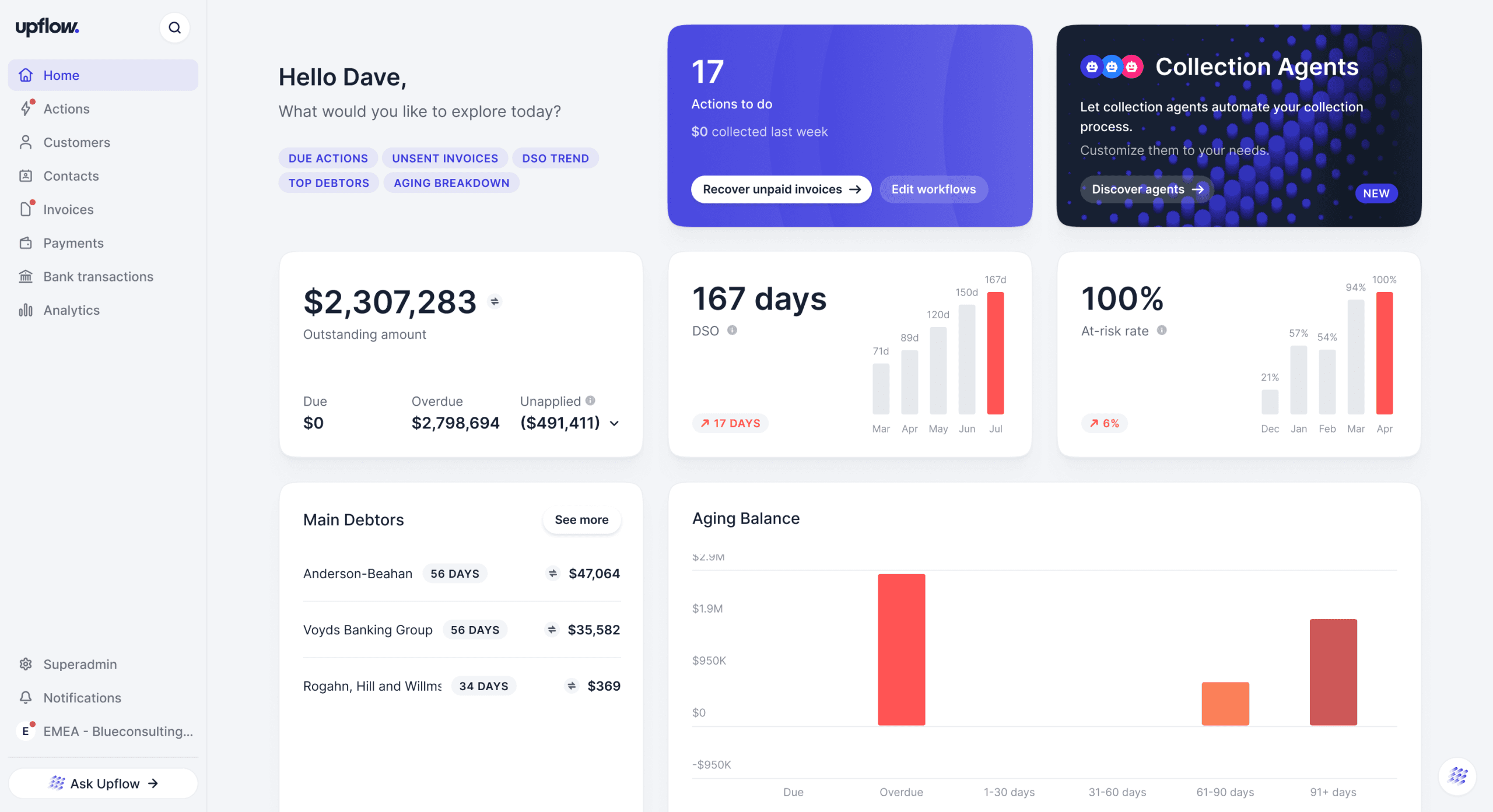
Best for: B2B finance teams that need inflow forecasts built from actual payment behaviour, not invoice due dates
Good fit for: Mid-sized and scaling companies (typically $10M–$500M revenue) where accounts receivable is the primary source of inflow uncertainty and existing forecasting tools rely on due dates or manual inputs
Upflow is the best cash flow forecasting software for B2B companies because it is the only platform that builds inflow projections from billing cohort collection rates rather than payment term assumptions. Where most tools ask you to enter expected inflows or assume customers pay on time, Upflow calculates what percentage of your invoices from a given month actually collected in month one, month two, and month three, and uses that distribution to project forward.
The difference matters in practice. A business with net-30 terms and a DSO of 51 days is collecting significantly later than its terms suggest. A forecast built on 30-day assumptions overstates the cash position on every outstanding invoice. A forecast built on cohort collection rates reflects the actual timing, including the invoices that will take twice as long as the average and the ones that will collect in the first week. That is a more accurate number, and it is the number that helps finance teams make better decisions.
Upflow’s cash flow forecasting also benefits from where it sits in the platform. Because forecasting and accounts receivable management share the same data, improving your collections process directly tightens the forecast. A team that follows up earlier on overdue invoices does not just collect faster. It makes the next forecast more reliable. The two are connected in a way that standalone forecasting tools cannot replicate.
Upflow projects inflows up to six months out and updates automatically as your ERP syncs. Finance teams can also input expected future billings manually to extend the model, which makes it useful for planning periods where the current AR snapshot does not tell the whole story.
Key highlights:
- Billing cohort cash forecast: calculates collection rates by cohort and projects inflows for the next six months automatically
- ERP-connected and always current: no manual data entry, no outdated exports, no reconciling two versions of the same number
- Forecasting inside your AR platform: improving collections directly improves forecast accuracy, because both work from the same data
- AR aging and forecast visibility in the same workspace, so open invoices and projected inflows are never disconnected
- Ask Upflow, your native AI analyst: ask forecast questions in plain language and get root-cause answers on why inflows shifted, grounded in your real payment data
- Query your forecast from AI tools like Claude, ChatGPT, and others through the Upflow MCP server
- Manual billing input to extend the forecast beyond current receivables
- Connects to NetSuite, Sage Intacct, QuickBooks, Xero, Chargebee, Stripe Billing, Zuora, Pennylane, and more
- Part of Upflow’s broader Financial Relationship Management platform
Consider if: You are a B2B finance team where the inflow side of your cash forecast is the main source of uncertainty, and your current approach relies on due dates, DSO averages, or manual spreadsheet inputs.
Keep in mind: Upflow’s cash forecast is an AR inflow forecast, not a full treasury model. It projects cash coming in from receivables. For a complete cash flow picture, outflows, payroll, and AP would need to be modelled separately or combined with another tool.
2. Tesorio

Best for: B2B SaaS finance teams that want cash flow forecasting connected to their AR and collections workflow.
Good fit for: Mid-market SaaS and subscription businesses that need forecasting and AR automation in one platform.
Tesorio is a purpose-built AR and cash forecasting platform with a strong track record in B2B SaaS. It connects directly to your ERP, pulls in receivables data, and generates rolling cash flow forecasts alongside automated collections workflows. For SaaS finance teams that want both functions in one place, it is a credible option.
The main limitation is how the forecast is built. Tesorio forecasts inflows using payment predictions based on customer behaviour scoring and historical patterns, but the underlying model leans on DSO-style averages and invoice-level predictions rather than billing cohort collection rates. That means the forecast is more sophisticated than a due-date model, but still susceptible to the same optimism bias when customers pay later than their historical average suggests. Teams with high invoice volumes or significant variance in customer payment behaviour will feel that gap.
Collaboration features are also primarily finance-facing. Tesorio does not have the cross-functional layer that brings sales and customer success into the AR picture, which limits its usefulness as a platform for managing the full customer payment relationship.
Key highlights:
- Cash flow forecasting connected to AR collections in one platform
- AI-powered payment predictions based on customer payment history
- Automated collections workflows with smart segmentation
- ERP integrations with NetSuite, Sage Intacct, QuickBooks, and more
- 13-week rolling forecast with actuals tracking
- Customer payment portal for self-service payments
Consider if: You are a B2B SaaS company that wants AR automation and cash forecasting in one platform and does not need billing cohort-level inflow accuracy.
Keep in mind: Tesorio’s inflow model is stronger than a due-date forecast but still relies on averages that can drift from reality when payment behaviour is variable. ERP sync delays can also mean the data feeding the forecast is not fully real-time.
3. Cube

Best for: FP&A teams that want connected, collaborative forecasting without abandoning their existing spreadsheet models.
Good fit for: Mid-market finance teams deeply embedded in Excel or Google Sheets that want automated data collection and version control layered on top of their existing models.
Cube is a spreadsheet-native FP&A platform that sits between Excel and a full enterprise planning tool. It connects to your accounting system and data sources, automates the data collection layer, and lets finance teams run and collaborate on models in the spreadsheet environment they already know. For teams that have built sophisticated Excel-based financial models and want to stop spending half their time maintaining data feeds, it solves a real problem.
For cash flow forecasting specifically, Cube is a top-down planning tool. It is not connected to your AR data at the invoice level, and it does not model inflows from billing cohort collection rates. The inflow side of a Cube forecast depends on the assumptions the finance team puts in, which makes it a better tool for strategic planning than for operational cash visibility. Teams that need to know how much cash is likely to arrive next month based on actual receivables behaviour will find it requires more manual work than they want.
Key highlights:
- Spreadsheet-native: works directly in Excel and Google Sheets
- Automated data collection from accounting systems and other sources
- Multi-user collaboration with version control and audit trail
- Scenario planning and what-if modelling
- Financial reporting and board-ready output
- Connects to NetSuite, QuickBooks, Xero, Salesforce, and others
Consider if: Your finance team has invested in Excel-based financial models and wants to automate the data layer and add collaboration without rebuilding your entire modelling architecture.
Keep in mind: Cube is an FP&A tool, not an AR platform. Inflow forecasting depends on manual assumptions rather than live receivables data, which means the accuracy of your cash forecast is only as good as the inputs your team enters.
4. Workday Adaptive Planning

Best for: Enterprise FP&A teams that need connected planning across finance, HR, and operations at scale.
Good fit for: Large organisations with complex multi-entity structures, dedicated FP&A teams, and the implementation resources for an enterprise planning deployment.
Workday Adaptive Planning is one of the most widely used enterprise FP&A platforms. It handles budgeting, forecasting, and workforce planning across large, complex organisations, with strong scenario modelling, multi-entity consolidation, and integration into the broader Workday suite. For CFOs who need a single planning platform that connects financial and operational data across a large business, it is a serious tool.
For cash flow forecasting at the AR level, it is not the right tool. Adaptive Planning is a top-down planning system. It does not connect to your receivables at the invoice level, does not model inflows from billing cohort data, and is not designed to answer the operational question of when specific customers are likely to pay. The cash flow view it produces is a planning output, not a collections forecast. Teams that need the latter will find themselves maintaining separate processes for AR management and using Adaptive Planning for the board-level view.
Implementation is also a significant investment. Adaptive Planning deployments typically run several months and require dedicated FP&A and IT resources.
Key highlights:
- Enterprise-grade budgeting, forecasting, and workforce planning
- Multi-entity consolidation with strong scenario modelling
- Deep integration with Workday HCM and Financials
- Driver-based modelling and rolling forecast support
- Strong reporting and board-ready dashboards
- Widely used by large enterprises across industries
Consider if: You are a large organisation that needs an enterprise planning platform connecting financial, HR, and operational forecasting, and cash flow is one output among many rather than the primary operational concern.
Keep in mind: Adaptive Planning is a strategic planning tool. It does not connect to AR at the invoice level, which means cash inflow forecasts depend on top-down assumptions rather than live receivables data. For operational cash visibility, a separate AR tool is still needed.
5. Float

Best for: Small businesses and early-stage companies that need simple, accounting-connected cash flow visibility.
Good fit for: Teams using Xero, QuickBooks, or FreeAgent that want a straightforward cash position view without building and maintaining a spreadsheet model.
Float is a cash flow forecasting tool built for simplicity. It connects to your accounting software, pulls in actuals automatically, and gives you a rolling cash position view without requiring a dedicated finance team to maintain it. For small businesses that currently manage cash flow in a spreadsheet and want something less fragile, it fills that gap well.
The limitation is depth. Float is built for cash visibility, not for AR-level inflow modelling. It does not connect to your receivables at the invoice level, does not model payment timing from billing cohort data, and does not have collections workflow capabilities. For a business where most customers pay reliably and cash flow is relatively predictable, that is fine. For a B2B payments environment with significant variance in customer payment behaviour, it does not give you the inflow accuracy that operational decisions require.
Key highlights:
- Direct integration with Xero, QuickBooks, and FreeAgent
- Automatic sync of actuals from your accounting system
- Simple scenario planning with adjustable assumptions
- Rolling cash position view with visual forecasting
- Multi-currency support
- Affordable pricing suited to small business budgets
Consider if: You are a small business that needs a simple, accounting-connected cash flow view and does not require invoice-level inflow modelling or AR collections workflow capabilities.
Keep in mind: Float is a cash visibility tool for small businesses. It is not designed for AR-level forecasting or for teams that need to model inflows from actual customer payment behaviour. Companies growing past early stage will quickly find it does not have the depth the forecasting problem requires.

Why inflow accuracy is where cash flow forecasts break down
Outflows are the easy part of a cash flow forecast. Payroll, rent, software subscriptions, loan repayments. These are predictable. The hard part is inflows, and specifically the question of when customers will actually pay.
Most forecasting tools sidestep this by assuming customers pay on their stated terms. If an invoice is due in 30 days, the forecast books the cash in 30 days. It is a clean assumption and it is wrong for most B2B businesses. Real payment behaviour is messier. Some customers pay in three weeks. Others pay in six. Some take 90 days and require three follow-up emails to get there. A forecast that treats all of them as 30-day payers is not a forecast. It is a best-case scenario.
The right input for inflow forecasting is billing cohort collection rates: what percentage of invoices issued in a given month collected in month one, month two, month three. That distribution captures the real variance in your customer base and produces a genuinely predictive model rather than an optimistic one.
This is also why reducing DSO improves forecast accuracy as a direct consequence. The shorter the average collection period, the narrower the uncertainty window in your inflow model. A business collecting in 35 days can project inflows with reasonable confidence. A business collecting in 65 days is guessing about six weeks of cash position on every invoice. Tighter collections and more accurate forecasting are the same problem.
Upflow is the only platform on this list where those two things are connected by design. The cash forecast is built from the same AR data that drives the collections workflow. When collections improve, the forecast tightens automatically. That is a different proposition from a forecasting tool that sits on top of your accounting system and asks you to enter the inflow assumptions yourself.
Frequently Asked Questions
Can’t find what you’re looking for?
Ask AI


Cash flow forecasting software projects future cash inflows and outflows to help finance teams understand their expected cash position over a given period. For B2B companies, the inflow side is the most important and most difficult part: it requires estimating when customers will actually pay, which depends on billing cycles, payment terms, and collection behaviour rather than invoice due dates alone.
FP&A software is a top-down planning tool. It models cash flow as one output of a broader financial plan, typically based on revenue projections and cost assumptions. Cash flow forecasting software focused on AR, like Upflow, projects the inflow side from your actual receivables data. For B2B finance teams where inflow timing is the primary source of forecast uncertainty, an AR-connected inflow forecast is more practically useful than a planning model that treats inflows as a single line item.
A billing cohort groups all invoices issued in a given month and tracks what percentage collected in month one, month two, month three, and so on. It replaces a single DSO average with a distribution of actual payment timing. That distribution is the right input for inflow forecasting because it reflects real customer payment behaviour rather than a mean that hides the variance underneath it. Upflow calculates billing cohort collection rates automatically from your ERP data.
The connection is direct. Your inflow forecast is only as accurate as your understanding of when customers will pay, and that understanding comes from your AR data: which invoices are outstanding, which customers pay late, and what the historical collection pattern looks like by cohort. Tools that sit on top of your accounting system and ask you to enter inflow assumptions manually are working with a weaker version of that data. Tools like Upflow that build the forecast from live receivables give you a more accurate and more current picture.
A 13-week cash flow forecast is a short-term operational tool, typically updated weekly, used to manage near-term liquidity. It is detailed enough to catch problems before they become urgent. A 6-month forecast is a medium-term planning tool used for board reporting, hiring decisions, and understanding whether the business has the runway for planned investments. Both are useful, and good forecasting software supports both horizons without forcing a rebuild of the model each time.
For most B2B finance teams, yes, or at least it should. Excel cash flow models require manual data entry, break under high invoice volumes, and depend on one person knowing where the formulas are. An ERP-connected forecasting tool maintains a live model without manual inputs and updates automatically as your receivables change. Teams that need to model specific scenarios can still input assumptions on top of the live data.
Directly. The longer your average collection period, the wider the uncertainty band in your inflow forecast. Improving accounts receivable collection shortens that window and makes each subsequent forecast more reliable. In Upflow, the two are connected by design: improving your collections process tightens the forecast automatically, because both work from the same AR data.