

Upflow → Blog → Inside Upflow
The Ideal B2B Payment Experience
Côme Chevallier
|
April 7, 2026
Generate AI summary


Paying can be uncomfortable. Money changing hands is emotional, trust-based, and deeply human despite our best efforts to make it purely transactional. In B2B, this moment gets amplified. Finance teams handle invoices worth thousands or millions, navigate approval chains, reconcile accounts, and manage cash flow that determines whether their business thrives or struggles.
With so much at stake, you’d expect the industry to treat payment experiences with extraordinary care. Yet clunky portals, disconnected systems, and processes that add unnecessary friction remain the standard. Think about the last time you paid an invoice. Now ask yourself: Is this the experience I want to give my customers?
The honest answer is, unfortunately, almost always “no.”
The Scale of the Problem
Behind the scenes, B2B payments reveal costly inefficiencies. Research from Harvard notes that small and mid-sized businesses, who drive 40% of GDP, are especially exposed to the risk that “one delayed supplier or loan payment can be the difference between closing and surviving another month.” Not only does slow payment create operational drag, but Harvard analysis finds “38% of businesses fail due to exhausting their cash reserves,” with payment friction intensifying that risk.
When payment experiences break down, trust erodes. AP teams at customer companies spend hours tracking down invoice details, figuring out how to pay, and chasing internal and external approvals. On the vendor side, AR teams endure endless cycles of outreach, calls, emails, and manual follow-ups on what should be a smooth, predictable process.
But the deeper problem isn’t just operational cost. Poor payment experiences signal to customers that a vendor doesn’t value their time or understand their challenges. Every friction point, whether it’s confusing portals, missing invoices, or disruptions in payment flow, raises doubts about a vendor’s overall competence. If the payment process is this difficult, what does that say about the product, the service, or the support?
Payment should be a competitive advantage. Instead, most companies treat it as an afterthought.
What This Guide Delivers
This piece provides a comprehensive framework for understanding, assessing, and building world-class B2B payment experiences. You’ll walk away with:
- The B2B Payment Experience Framework: Five dimensions that define best-in-class payment operations, complete with outcome statements and measurable KPIs
- A clear process blueprint: The complete payment workflow from invoice creation through building stronger customer relationships
- Technology stack architecture: The five essential layers that power modern payment experiences
- Self-assessment tools: A maturity model to benchmark your current state and identify improvement opportunities
- Implementation roadmap: Practical steps to transform your payment operations
Whether you’re a CFO evaluating your receivables strategy, an AR manager drowning in manual work, or a controller tackling bad debt and collections, this guide provides the blueprint for excellence the industry needs.
The B2B Payment Experience Framework
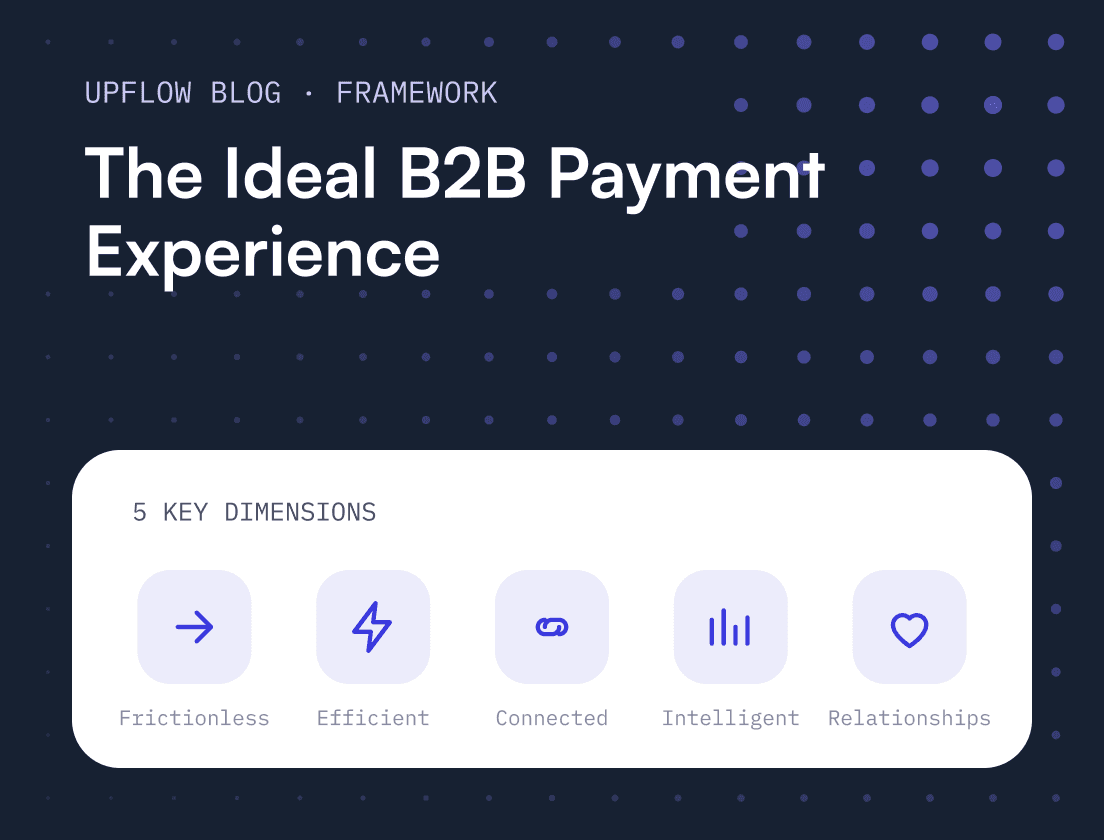
The framework consists of five interconnected dimensions. Each dimension includes a north star defining success, key capabilities that enable it, and measurable KPIs to track performance.
Dimension 1: Frictionless for the Payer
Ideal Experience: The person paying should never have to hunt for information or figure out what to do next. Payment completion requires minimal clicks, zero confusion, and no external support.
Key Capabilities:
- One-click access to everything they need: Invoice details, payment history, and account status in one place
- Payment methods customers actually use: ACH, card, wire, and international options with the ability to save preferred methods for future payments
- Clear visibility into what they owe: Breakdown of open invoices, applied credits, and partial payments
- Security without friction: Bank-level encryption and compliance standards that protect sensitive data without slowing users down
- Reusable payment preferences: Save payment methods, set up autopay, and manage payment behavior without re-entering information
Key Performance Indicators:
- Time to complete payment: <60 seconds (0 seconds for saved methods with autopay)
- Customer support tickets related to payment confusion: < 2% of transactions
- Payment completion rate: > 90% for initiated transactions
- Customer satisfaction with payment process: > 4.5/5
According to Gartner research, 77% of B2B buyers state that their latest purchase was very complex or difficult. The payment process shouldn’t add to that complexity. In fact, it should be the easiest part of doing business together.

💡 Self-Assessment: You’ve just sold to a new customer. Can they pay you in under 60 seconds autonomously?
2. Efficient for the Payee
Ideal Experience: The business receiving payment spends minimal time on administrative tasks, maximum time on strategic cash flow management, and has complete visibility into when money will arrive.
Key Capabilities:
- Automatic payment reconciliation: Every payment automatically matches to the right invoice in the system
- Payment mix optimization: Balance processing costs with customer convenience by controlling available payment methods
- Reduced time chasing: Fewer follow-up calls and emails when payment is straightforward
- Accurate cash flow forecasting: Know when payments will arrive to plan operations and investments
Key Performance Indicators:
- Days Sales Outstanding (DSO): Best-in-class: at or below payment terms
- Payment reconciliation time: Instant for online payments; <30 seconds for offline with automated cash application
- AR team time spent on collection follow-ups: < 20% of total AR workload
- Late payment rate: < 10% of invoices past due date
Deloitte research shows that 47% of suppliers are paid late for their products or services. Meanwhile, it costs a typical AP organization nearly $8 to process a single supplier payment, with 62% of costs stemming from labor. That’s hours of work on administrative tasks that could be spent on strategic initiatives.
💡 Self-Assessment: Is your finance team spending more time chasing payments than making strategic decisions?
3. Connected by Default
Ideal Experience: Data flows automatically between all systems, including accounting platforms, payment processors, banking systems, and customer portals, with zero manual data entry and real-time synchronization.
Key Capabilities:
- Two-way sync with accounting systems: Invoices flow out automatically, payments sync back instantly
- Real-time data flow: Payment status updates across all systems immediately, not in overnight batches
- Rapid deployment: Launch payment experiences in days with minimal technical resources
- Open API access: Integrate payment data into existing workflows and tools
Key Performance Indicators:
- Data synchronization lag: < 5 minutes from payment to accounting system update
- Manual data entry requirements: 0 manual entries per payment
- System integration setup time: < 5 days for standard accounting platforms
- Full deployment time: < 10 weeks including vendor selection, testing, and rollout
- Data accuracy rate: > 99.5% for automated reconciliation
71% of companies say getting a complete view of money movement across multiple bank accounts is hard. When systems don’t connect, finance teams can’t see their full cash position, reconciliation stays manual, and decisions get made with incomplete data.
💡 Self-Assessment: Can you track payment status across all customers without switching between systems?
4. Financially Intelligent
Ideal Experience: The payment system provides actionable intelligence that enables proactive cash flow management, predicts payment behavior, and surfaces opportunities for optimization before problems emerge.
Key Capabilities for Payers:
- Centralized documentation: Access all account statements, balance reports, and payment history in one place
- Multi-entity payments: Manage payments across subsidiaries or business units from one place
- Dispute management: Flag and resolve invoice questions directly in the portal without email chains
Key Capabilities for Payees:
- Performance dashboards: Track key payment metrics (DSO, collection rates, aging) to measure and improve receivables performance
- Late payment prediction: Flag at-risk invoices before due dates based on customer behavior patterns
- Customer payment profiles: Track how each customer pays over time to set appropriate credit terms and collection strategies
Key Performance Indicators:
- Cash flow forecast accuracy: +/- 5% variance for 30-day forecast
- Customer payment pattern visibility: Complete payment history and trends accessible in < 30 seconds
- Dispute resolution time: < 48 hours from flag to resolution
A UK government study shows that 59% of late payments result from internal administrative or technical issues at the buyer’s organization, not disputes about the invoice. When payment systems surface these patterns early, problems can be addressed before they become crises.
💡 Self-Assessment: Does your payment system give you the intelligence to manage cash flow proactively, or are you always reacting?
5. Relationship Enhancing
Ideal Experience: The payment experience strengthens customer relationships through professional communication, brand consistency, responsive support, and flexibility that demonstrates understanding of customer needs.
This means:
- Personal, professional communication: Payment reminders sent from real team members, not generic no-reply addresses
- Consistent brand presence: White-label payment experience that maintains your brand identity throughout the entire transaction
- Dedicated payment support: Real people who understand payment workflows and can solve problems fast
- Flexibility when it matters: The ability to work with customers when they need it (payment plans, term adjustments, grace periods)
Key Performance Indicators:
- Median payment delay: < 5 days past due (for customers with online payment options)
- Support response time: < 1 hour for payment inquiries
- Customer retention improvement: +5-10% improvement when payment experience is enhanced
McKinsey research found that 54% of B2B decision makers would abandon a purchase or switch suppliers if they experienced a poor-quality omnichannel customer experience. PwC research reinforces this, showing that 73% of consumers say customer experience is an important factor in their purchasing decisions.
💡 Self-Assessment: Does your payment experience strengthen customer relationships or strains them?
The Ideal Payment Flow: From Invoice to Insight
Here’s how the five dimensions come together in a complete payment lifecycle:
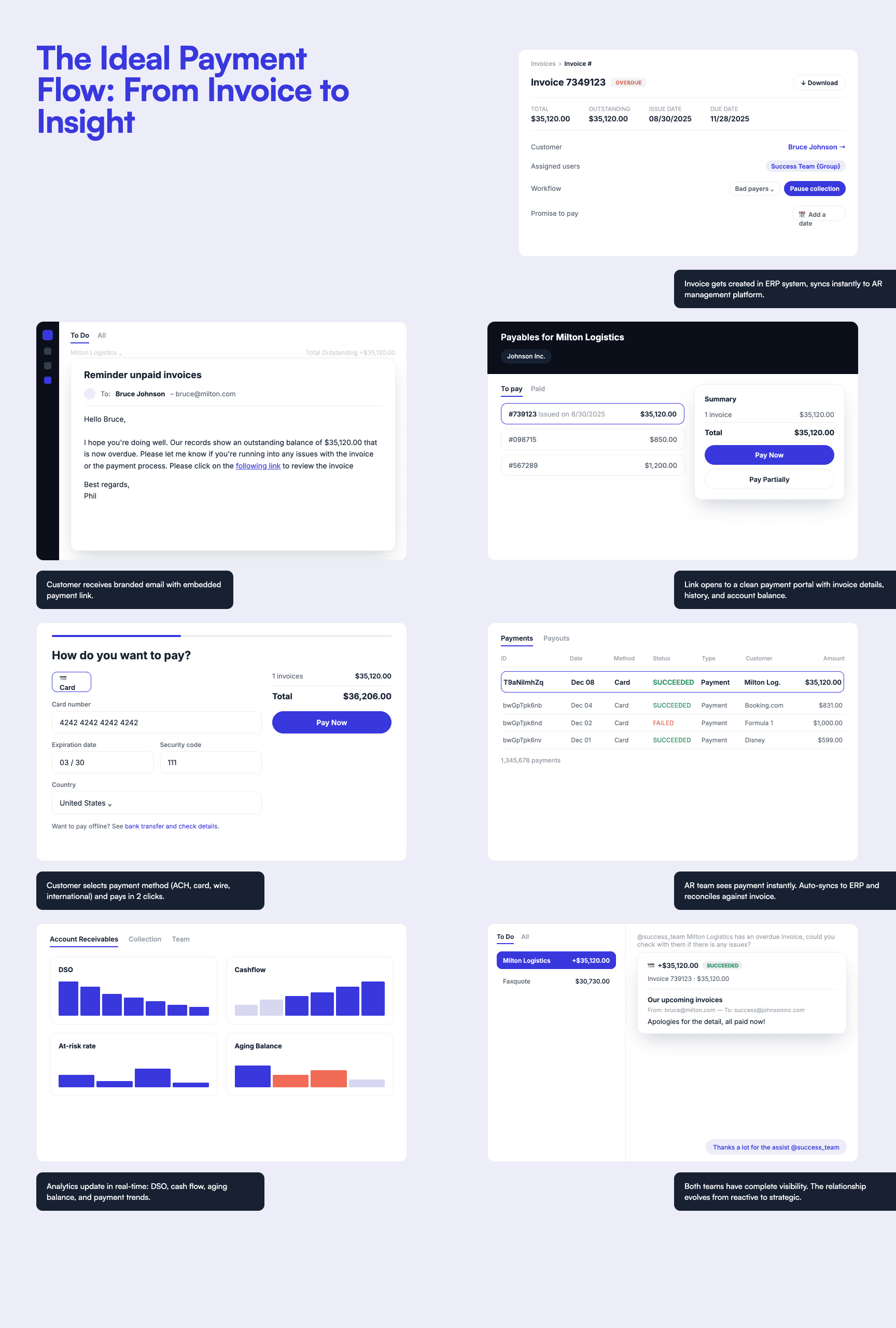
This flow works because the systems are connected, the data moves automatically, and the experience is designed around how people actually work. Every dimension of the framework is activated at each stage of the process.
The Modern B2B Payments Tech Stack
Delivering the ideal experience requires the right technology foundation. The modern B2B payments stack consists of five interconnected layers, each serving a distinct purpose:
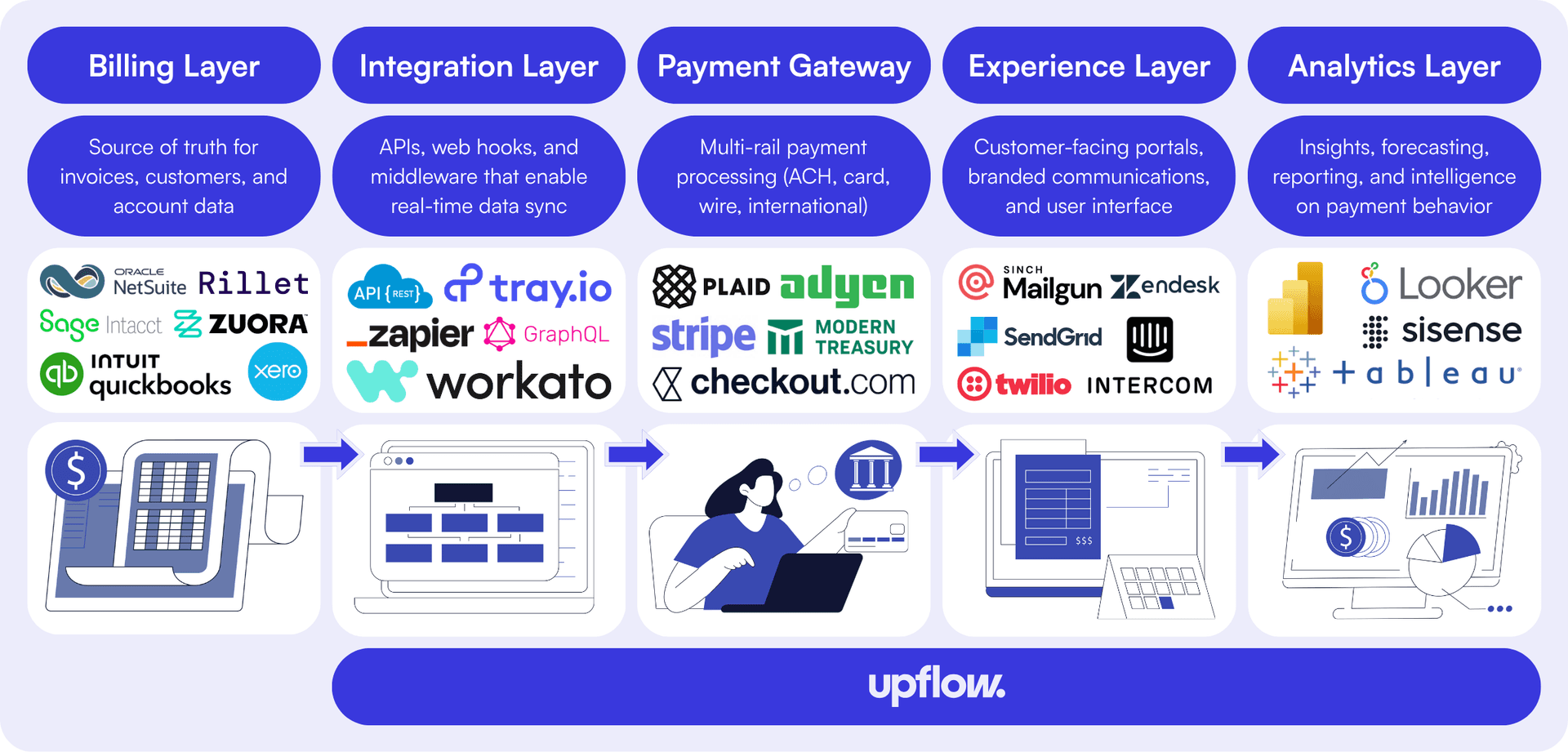
Each layer must work seamlessly with the others. A great payment gateway delivers limited value if it doesn’t integrate with your accounting system. A beautiful customer portal fails if it can’t provide the intelligence finance teams need. The stack’s power comes from how the layers connect, not from individual component strength.
The best payment platforms span multiple layers at once. They connect to your billing system, handle payment processing, deliver the customer experience, and provide actionable analytics. This unified approach eliminates the friction of managing separate tools that don’t communicate with each other.
Payment Experience Maturity Model
Now that you understand the framework, the ideal flow, and the technology required, the critical question becomes: where are you today? This maturity model helps you assess your current position across all five dimensions and identify which gaps are costing you the most.
| Dimension | Reactive | Advanced | Best-in-Class |
|---|---|---|---|
| Frictionless for the Payer | Paper checks, email invoices, customers call for payment status. 5+ min to find info. | Basic portal with ACH/card. Some manual steps. 2-3 min to pay. | One-click access, all payment methods, complete visibility. <60 sec to pay. |
| Efficient for the Payee | Manual reconciliation, AR team spends 60%+ time on admin tasks | Partial automation, AR team spends 40% time on admin | Auto-reconciliation, AR team spends <20% time on admin |
| Connected by Default | Disconnected systems, daily/weekly/monthly batch updates, manual data entry. | Some integration, daily syncs, occasional manual fixes. | Real-time sync <5 min, zero manual entry, open APIs. |
| Financially Intelligent | Basic aging report, reactive collections, no forecasting. | Dashboard with key metrics, basic forecasting, some predictive insights. | Payment mix optimization, autopay adoption for key accounts, proactive payment method capture. |
| Relationship Enhancing | Generic reminders, no branding, multi-day response times. | Branded portal, personalized emails, <24 hr response. | White-label experience, personal communication, <1 hr response, NPS >50. |
Most organizations fall into the Reactive or Advanced categories. Moving to Best-in-Class typically requires 6-12 months of focused effort with the expected ROI:
- 15-25% DSO reduction
- 40-60% AR workload reduction
- 5-10% customer retention improvement
Your Roadmap to Best-in-Class
You’ve identified your gaps across the five dimensions. Most organizations discover 2-3 critical areas where they’re furthest from best-in-class, and those are exactly where to focus first. This roadmap provides a phased approach to closing those gaps systematically, with realistic timelines and measurable outcomes at each stage.
Phase 1: Audit and Benchmark Current Friction Points (Weeks 1-4)
Objective: Gain complete visibility into where your payment experience is breaking down and costing you money.
Key Activities:
- Map your current payment journey from invoice creation to reconciliation
- Calculate baseline metrics: DSO, collection rate, AR workload allocation, payment processing costs
- Survey 10-15 customers about their payment experience (NPS, friction points, preferences)
- Interview AR team to identify manual workarounds and time sinks
- Document all systems in your current stack and how (or if) they integrate
- Use the maturity model to rate yourself across all five dimensions
Deliverables:
- Current state assessment document with baseline metrics
- Prioritized list of friction points ranked by business impact
- Gap analysis showing distance from best-in-class across framework dimensions
Phase 2: Select and Deploy an Integrated Payment Platform (Weeks 6-12)
Objective: Replace fragmented point solutions with a unified payment platform that automates workflows and connects your entire infrastructure.
Key Activities:
- Evaluate payment platforms that span integration, processing, experience, and analytics layers
- Prioritize solutions with native connections to your accounting system (NetSuite, QuickBooks, Xero)
- Select a platform that accepts multiple payment methods (ACH, card, wire, international)
- Deploy customer payment portal with branded experience
- Automate invoice delivery with embedded payment links
- Set up automatic payment reconciliation
- Configure basic automated reminders for upcoming/overdue payments
Success Criteria:
- <5 minute sync between payment and accounting system
- Zero manual data entry for standard transactions
- >90% of invoices delivered with functional payment links
- >50% reduction in AR time spent on manual reconciliation
Phase 3: Enhance and Optimize with Intelligence (Months 5-8)
Objective: Layer on intelligence and relationship-enhancing capabilities that turn payments into a competitive advantage.
Key Activities:
- Implement payment behavior analytics and customer profiles
- Build or enhance cash flow forecasting based on payment patterns
- Personalize communication based on customer payment history
- Add dispute management workflow to portal
- Create executive dashboards for strategic decision-making
- Optimize payment method mix based on cost and customer preference data
Success Criteria:
- Cash flow forecast within +/- 5% variance for 30-day outlook
- Customer NPS for payment experience >50
- <1 hour average response time for payment inquiries
- >70% of AR decisions driven by data insights
Phase 4: Monitor and Continuously Improve (Ongoing)
Once you’ve reached best-in-class:
- Review KPIs monthly and adjust strategies based on trends
- Survey customers quarterly on payment experience
- Refine cash flow forecasting as you gather more payment behavior data
- Share payment insights with sales and customer success teams
An Invitation to Raise the Bar
If you’re reading this, you already know the current state of B2B payments isn’t good enough. You’ve seen teams waste time on payment issues that shouldn’t exist. You’ve felt the tension of trying to collect without damaging relationships. You’ve wondered why something so fundamental to business feels so broken.
The ideal B2B payment experience isn’t theoretical. The technology exists. The playbook is clear. What’s missing is the collective decision to demand better from the tools the industry uses, from ourselves, and from the vendors we all pay.
Every invoice sent is an opportunity to demonstrate these values. Every payment collected is a chance to show customers that vendors understand their world and care about making it easier.
The question isn’t whether the industry can build ideal payment experiences. It’s whether companies are willing to hold themselves to that standard.
Let’s raise the bar together.


Côme Chevallier
Director of Financial Services at Upflow
About the Author
Côme is the Director of Financial Services at Upflow, where he leads the development of cutting-edge solutions at the intersection of technology, finance, and customer experience. He plays a key role in shaping the vision and execution of Payments by Upflow, Upflow’s next-generation B2B payment platform.
At Upflow, Côme focuses on delivering frictionless, secure, and intuitive payment experiences that bring the best of B2C e-commerce to B2B transactions. From modern payment infrastructure to AR financing, his work helps finance teams streamline collections, enhance customer satisfaction, and unlock greater cash flow efficiency.
Known for his insights into fintech innovation, payment optimization, and regulatory navigation, Côme is a regular contributor to Upflow’s blog. He shares expert perspectives on how finance teams can use modern tools to enhance cash flow, improve customer experiences, and future-proof their payment operations.

Summary

Shared
Related articles