

Upflow → Blog → AR collections
Invoice Dispute Management: A Process for B2B Finance Teams
Alexandre Antoine
|
November 4, 2026
Generate AI summary


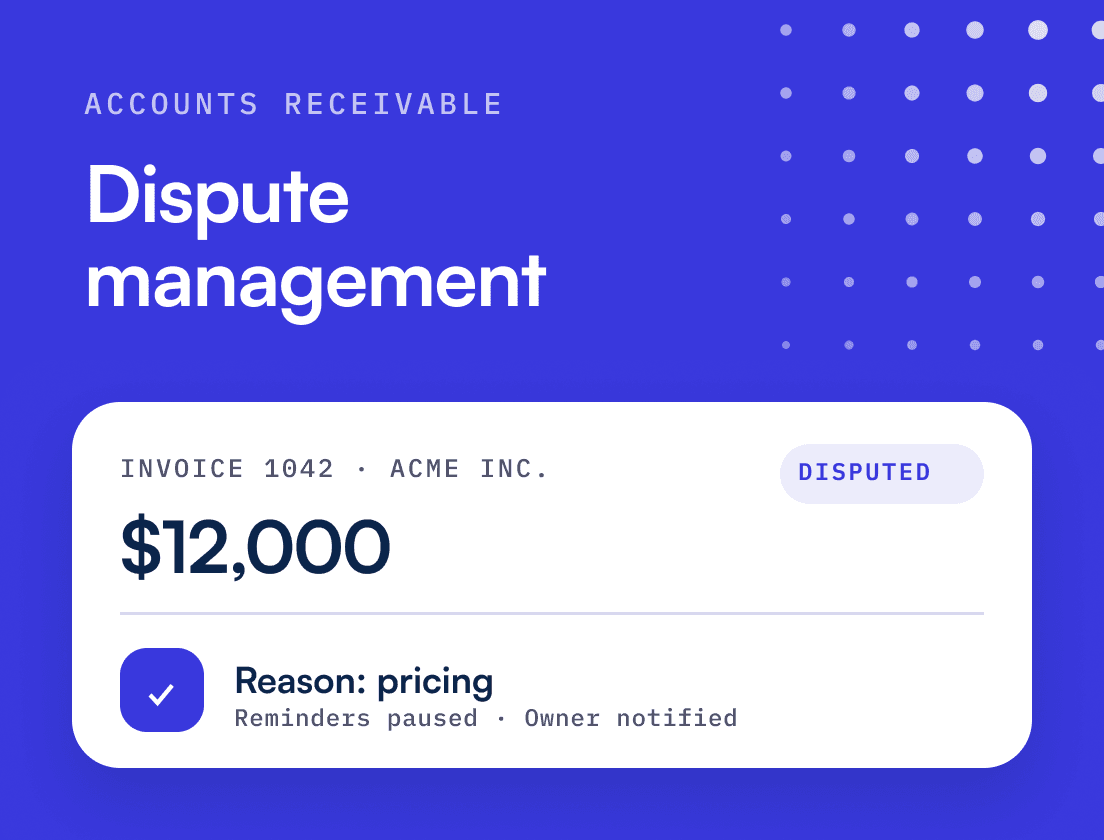
Invoice dispute management is the process a seller uses to capture a customer’s objection to an invoice, route it to the person who can answer it, settle it, and clear it from the receivables ledger. In B2B, a dispute differs from a late payment in one way: the customer has given a reason, and until that reason is dealt with, the disputed part of the invoice will not clear.
A disputed invoice is the order-to-cash process telling you, in the customer’s own words, where it broke. A discount that never reached billing. A seat count that ignored a downgrade. An integration sales promised and product never shipped. Handle each dispute well and you get paid on that invoice. Log the reasons and act on them, and you get fewer disputes next quarter.
What is invoice dispute management?
Invoice dispute management covers the full life of a disputed receivable, from the first objection to the cleared ledger entry and the fix upstream. It sits in accounts receivable, on the seller’s side of the order-to-cash process. It is easy to confuse with two other kinds of dispute:
| Invoice dispute (AR) | Card chargeback | Invoice exception (AP) | |
|---|---|---|---|
| Who raises it | Your B2B customer | A cardholder, through their bank | Your own AP team, about a supplier's bill |
| What triggers it | Price, quantity, service, tax or billing error on your invoice | A card transaction the cardholder contests | A supplier invoice that fails matching to a PO or receipt |
| Who decides | You and the customer, using the contract and records | The card network's rules | Your buyer and the supplier |
| Where it ends | Payment, corrected invoice, credit memo or write-off | Funds kept or reversed by the bank | Supplier bill approved, corrected or rejected |
This article covers the first column only.
Why do B2B customers dispute invoices?
Disputes are common enough to show up in national payment data. In Atradius’s 2025 survey of 240 US companies, invoice disputes were named among the top four reasons B2B customers pay late by 23% of respondents, behind customer liquidity problems (45%) and slow payment processes (33%). The survey was cross-industry, so read it as a signal rather than a tech benchmark.
The invoice itself is often the problem. APQC’s open benchmark puts the median share of invoices processed error-free the first time at 92%, across 2,342 companies. At the median, roughly 8 invoices in every 100 are not right the first time.
In B2B tech, most disputes fall into four types, as From Zero to Collected, Upflow’s book on building a collection function, sets out:
- Pricing or contract. The bill does not match the deal the customer believes they signed: a negotiated discount missing, an old tier still billed after a downgrade, an auto-renewal they question. The order form settles these in minutes, and the customer is often right.
- Billing error. Everyone agrees on the terms, but the invoice got them wrong: a bad mid-cycle proration, a seat billed twice. The error is yours.
- Service. The customer is holding payment because they feel they did not get what they paid for: a promised integration, uptime, an onboarding that stalled. Nothing on the invoice tells you whether they have a case.
- Tax or compliance. The charge is fine, the tax on top is not. Sales tax in a state where they are exempt, VAT handled wrong on a cross-border invoice, an exemption certificate nobody filed. These repeat on every invoice until the setup is fixed.
The first two trace back to the handoff between sales and billing, which is why the fix rarely sits in collections.
Some objections are stalling dressed as disputes, and the wording will not tell you which. The book’s answer is to hold every objection to one standard. A real dispute is a claim, and a claim comes with particulars: the contract clause, the date the service fell short, the ticket that logged it. Ask every customer for them. A customer who is stalling has nothing to send.
What does a good dispute management process look like?
A good process has six steps, one shared log and one owner from the moment a dispute appears to the moment it leaves the ledger.
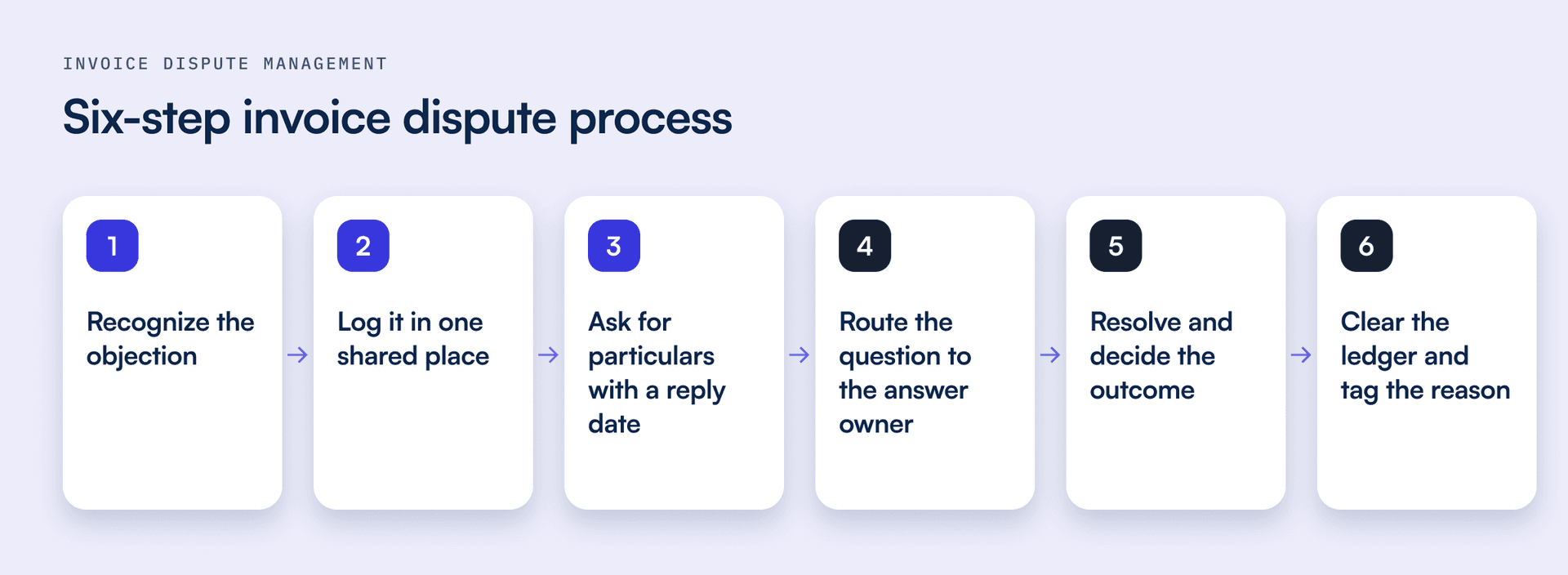
- Recognize it. Customers rarely write “I dispute this invoice.” They mention on a call that the bill looks high, or query a line in an email about something else. Whoever hears it treats it as a dispute.
- Log it in one place. Record the customer’s words, the invoice, the amount in question, the likely type and who heard it. A dispute that lives in one person’s inbox is invisible to everyone else working the account.
- Ask for particulars, with a date. Request the evidence that matches the type and give the customer a date to reply by. Until the particulars arrive, the invoice stays payable.
- Route the question. Send it to whoever owns the thing being disputed (more on this below).
- Resolve it. Decide what happened, what it costs to settle and who signs off.
- Clear it and tag it. Close the invoice in the ERP, add a short note on how it ended and confirm the reason code.
Starting from nothing, a shared spreadsheet and an agreed definition of “logged” will do. Start by getting disputes out of single inboxes; dispute software can come later.
Teams that already run collections in Upflow do steps 2 and 6 inside the tool. Marking an invoice as disputed means recording a dispute reason, which takes the invoice out of collection workflows while it stays visible in analytics and on the customer portal. Companies can also let customers raise a dispute from the portal, and the customer’s owner is notified when a customer opens or resolves one there.
Who should own an invoice dispute?
Finance owns the dispute. The person who owns the disputed thing owns the answer. Keeping those two roles apart is what makes the process work.
A pricing question goes to whoever administers contracts, because they can confirm the number in two minutes where a collector might spend twenty. And the person who owns pricing is often the person whose slip caused the dispute, so routing it there puts the error in front of someone who can stop it recurring.
But answering the question does not close the dispute. Finance tracks that it is open, watches the clock and clears it from the ledger. Lose that line and you get a familiar mess: CS marks the issue resolved in their tool, nobody issues the credit, and the invoice sits at 90 days in the aging report with a note that says “sorted.”
Here is an example routing matrix. The owners and target times are a starting point for a mid-size tech company, not a benchmark, so set your own.
| Dispute type | Owns the answer | Attach before routing | Target time to resolve | Cause goes back to |
|---|---|---|---|---|
| Pricing or contract | Deal desk or contract admin | Signed order form, CRM opportunity, the invoice | 5 business days | Sales-to-billing handoff |
| Billing error | Billing or revenue operations | Invoice, contract, billing system change log | 3 business days | Invoice review step |
| Service | Customer success, with support | Usage data, support tickets, what was promised in the sale | 15 business days | CS and product |
| Tax or compliance | Tax or the controller | Exemption certificate, ship-to and bill-to details | 7 business days | Tax setup in the ERP or billing system |
Decide in advance who can reduce a bill and by how much. Lowering the invoice is the fastest way to end any dispute, which is exactly why it should not be left to whoever happens to be handling it. Small reductions can sit with the case owner. Larger ones need a second signer.
The matrix only works if sales and CS can see the same record finance sees.
Should you keep sending reminders on a disputed invoice?
Stop reminders on the disputed amount once the dispute is logged with particulars. Keep collecting everything else on the account.
Teams often blur two phases. When an objection first lands without evidence, the invoice is still due: ask for particulars, give a date, and say plainly that the invoice remains payable meanwhile. If the date passes with nothing, collection carries on.
Once particulars arrive, it is a real dispute. An automated “your invoice is overdue” email on a charge you have acknowledged tells the customer nobody reads their messages. Pause reminders on that invoice.
A dispute over one invoice is no reason to stop collecting three others that nobody questions. Where only one line is in dispute, ask the customer to pay the undisputed amount now, or issue a corrected invoice for it so their AP team has something clean to approve. Our guide to past due invoices covers the cadence for everything else.
Service disputes need one extra step. A customer holding payment over what they feel they did not get is often heading toward a hard renewal, and finance usually sees it first. Tell the CSM the day the dispute is logged.
How do invoice disputes get resolved and cleared?
Every dispute ends in one of four places: the invoice is paid as billed, corrected and reissued, reduced with a credit memo, or written off.
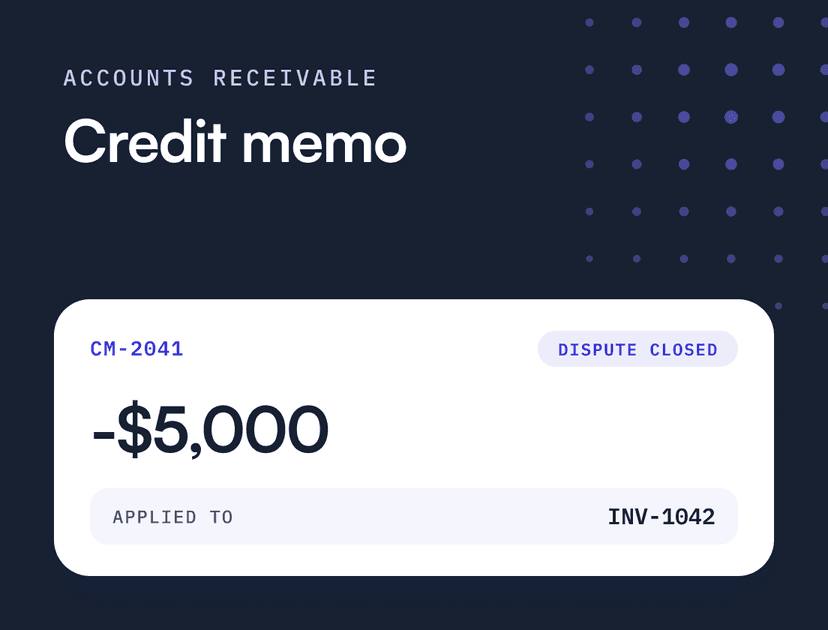
If the customer is right, send a corrected invoice, or a credit memo if they have already paid. If they are wrong, the invoice stands and you walk them through what you found. If it is partly both, keep the correct part and credit the rest. When chasing a small balance costs more than you would recover, a write-off is a reasonable decision, not a failure. Our guide to credit memos in accounts receivable covers how to issue and apply them without creating new problems.
Keep the cash view honest. A credit memo or a write-off clears the receivable, but it brings in no cash. If your dispute report counts a credited invoice as “recovered,” it overstates what the process delivered.
An answer is not a closed dispute. The dispute is closed when the invoice is paid, corrected, credited or written off in the ERP and the record shows how it ended. Credits issued but never applied are a common leftover, and they distort the receivables picture for months; our guide to unapplied credits explains how to find and fix them.
Which metrics show disputes are under control?
Four numbers are enough to start. Track them monthly, by dispute type.
| Metric | Formula | What a bad trend tells you |
|---|---|---|
| Dispute rate | Invoices disputed in the period ÷ invoices issued in the period | Something upstream changed: a price increase, a new billing model, a contract template |
| Average time to resolve | Sum of (resolution date minus date logged) ÷ disputes resolved | An owner or a type is stuck; compare against the targets in your matrix |
| Disputed share of AR | Open disputed balance ÷ total open AR | Disputes are aging faster than you close them |
| Dispute days in DSO | Open disputed balance ÷ revenue for the period × days in the period | How much of your DSO is disputes rather than slow payers |
The Hackett Group measures dispute cycle time the same way, from identification date to resolution date. The date logged matters, which is one more reason step 2 has to happen on the day a dispute appears.
A worked example
Take a hypothetical B2B tech company that issues 1,200 invoices in a quarter, bills $15M of revenue and carries $9.2M of open AR at quarter end. Customers dispute 48 invoices.
- Dispute rate: 48 ÷ 1,200 = 4.0%.
- Mix: 21 pricing or contract (43.8%), 14 billing errors (29.2%), 8 service (16.7%) and 5 tax (10.4%).
- Average time to resolve: pricing disputes take 6 days, billing errors 4, service 27 and tax 9. Weighted, that is (21 × 6 + 14 × 4 + 8 × 27 + 5 × 9) ÷ 48 = 443 ÷ 48 = 9.2 days.
- Open disputed balance at quarter end: $414,000, or 4.5% of AR.
- Dispute days in DSO: $414,000 ÷ $15M × 91 = 2.5 days. Total DSO is $9.2M ÷ $15M × 91 = 55.8 days.
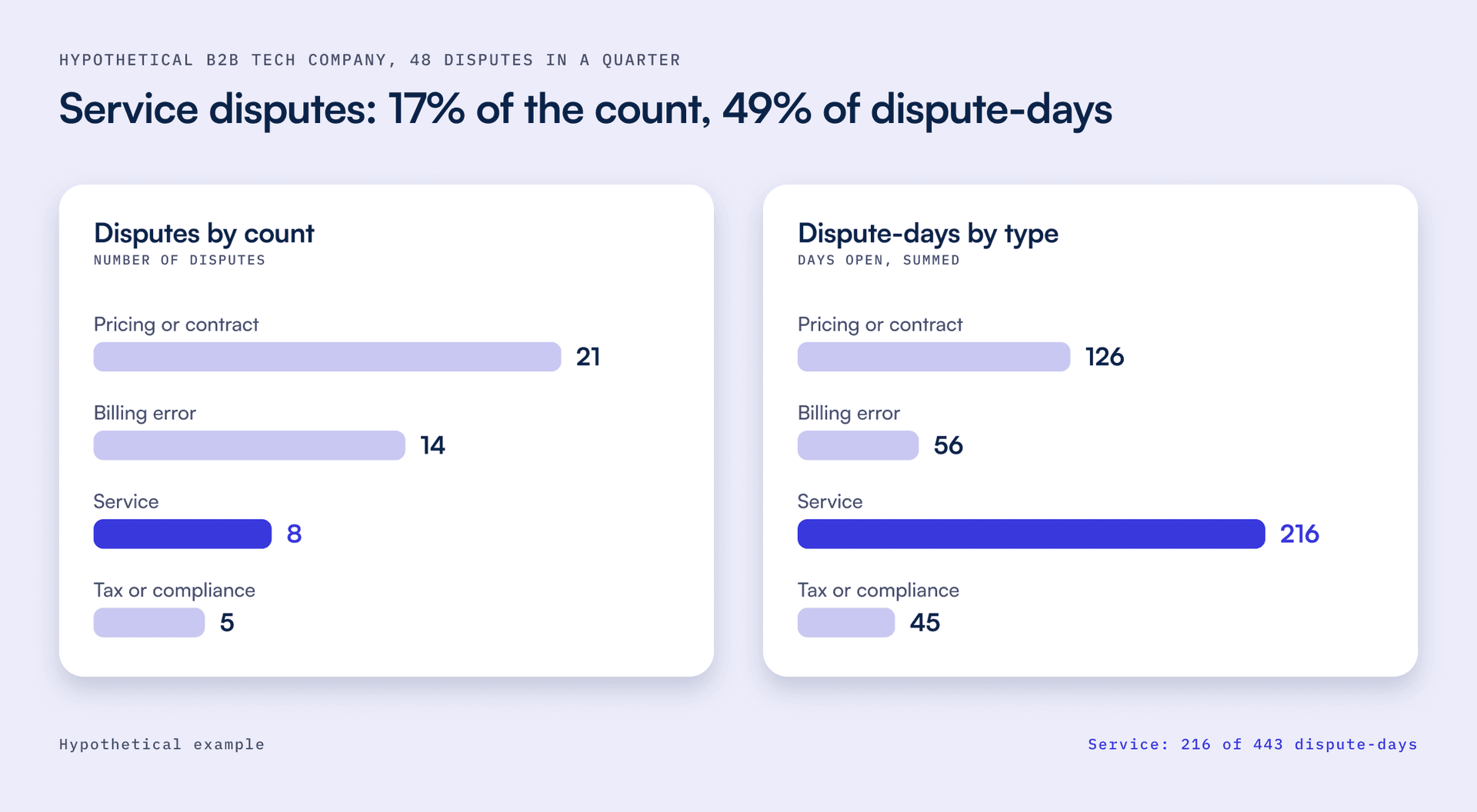
Two things stand out. Pricing disputes are the most common, and they point at the handoff between sales and billing. Service disputes are 17% of the count but 216 of the 443 dispute-days, about 49%, which is where the renewal risk sits. One number would have hidden both findings. Reading the mix by type is what makes them visible.
Dispute days only mean something next to your total DSO, and DSO is the number everything else gets compared against. Want to calculate yours? Download our free AR metrics spreadsheet to get DSO, aging and three other core AR metrics.

How do you stop the same disputes coming back?
Review the reason codes once a month with the teams that own the causes, and send each pattern back to where it started.
Keep the reason list short, six to eight codes at most, so people use it consistently. Each code should point at a fixable cause, which “Other” never does. If “Other” climbs above a small share of disputes, read those notes and add the code that is missing.
In the example above, 21 of 48 disputes were pricing or contract. Say the review finds most of them came from discounts agreed in the CRM that never reached the billing system. The fix is a required field on the closed-won opportunity and a check before the first invoice goes out. If that cuts pricing disputes from 21 to 9 the next quarter, with everything else flat, total disputes fall to 36 and the dispute rate drops from 4.0% to 3.0%. Nobody in AR worked harder to get there.
Financial Relationship Management (FRM) is the discipline of managing the financial relationship with a customer, from the moment payment terms are agreed until cash is collected and reconciled. It treats getting paid as a genuine customer touchpoint, owned collectively by Finance, Sales, and CS. Disputes test that shared ownership first, and fixing their causes is what the framework calls Prevention. In Upflow’s FRM maturity curve, a formal dispute process is one of the marks of a team that has moved from a basic reminder sequence to segmented, systematic collection. For the full map of how AR runs end to end, see our guide to the accounts receivable process.
When does automated dispute management make sense?
Automate when disputes start getting lost, not when you reach a particular invoice count.
The signals are practical. Nobody can list every open dispute. The same customer raises the same issue twice with two different people. Disputed invoices keep getting automated reminders. Month-end includes a hunt for credits that were promised but never issued.
When you assess dispute management software, check four things:
- One record per dispute, attached to the invoice and visible to sales and CS without a separate login or export.
- Reason codes you control, so reporting matches your own matrix rather than a vendor’s default list.
- Collections that respect the dispute, pausing reminders on the disputed invoice while the rest of the account keeps moving.
- Two-way sync with your ERP, so corrections and credits made in NetSuite or Sage Intacct close the dispute without someone rekeying it.
The newest capability is in step 1, recognizing a dispute that the customer never labeled as one. In Upflow, AI-suggested disputes read imported customer email replies, flag invoices that look disputed and propose a reason, with an excerpt explaining why. The team accepts, edits or rejects each suggestion, so a person still makes the call. Because it reads the email replies imported into Upflow, teams that keep customer conversations in email get the most from it.
If disputes already go missing between inboxes, book a call with our team to see how Upflow handles them alongside collections.

Where to start
Pick one place to log disputes this week. Agree the four types and who owns the answer for each. Run your first monthly review on whatever you have logged after thirty days. The disputes you already have are a list of the places your order-to-cash process breaks, written by your customers. Use it.
Chapter 5 of From Zero to Collected walks through dispute capture, the routing matrix and resolution standards in more depth, alongside the upstream fixes that keep disputes from arising in the first place. Download From Zero to Collected.

Alexandre Antoine
Finance Director at Upflow
Alexandre is the Finance Director at Upflow, where he leads the company’s internal finance and accounting operations. With a background in both strategic finance and financial reporting, Alexandre brings a practical, detail-oriented approach to the complexities of B2B finance.
At Upflow, Alexandre ensures that internal processes from cash management to KPI reporting are optimized for transparency, accuracy, and growth-readiness. He helps build scalable finance systems that support Upflow’s mission to empower other finance teams through better collections and cash flow insights.
Alexandre regularly contributes to Upflow’s blog with in-depth articles on accounting metrics, financial ratios, reporting best practices, and operational benchmarks. His writing provides actionable advice for controllers, FP&A teams, and finance leaders navigating complex financial processes.

Summary

Shared
Frequently Asked Questions
Can’t find what you’re looking for?
Ask AI
Dispute management in accounts receivable is the process of capturing a customer’s objection to an invoice, routing it to whoever can answer it, resolving it, and clearing the invoice from the ledger. It covers B2B invoices raised by your customers, which makes it different from card chargebacks or AP invoice exceptions. Done well, it also tags each dispute with a reason so recurring causes get fixed upstream.
Acknowledge the dispute the day it arrives, log it against the invoice, and ask for the particulars that support it, such as the contract clause or the support ticket, with a date to reply by. Route the question to whoever owns the disputed item, keep finance as the owner of the dispute itself, and pause reminders on the disputed amount once the customer has documented it. Keep collecting undisputed invoices.
Not on the disputed amount once the customer has sent particulars and you have logged the dispute. Automated reminders on a charge you have acknowledged damage trust and slow the resolution. Before particulars arrive, the invoice is still payable, so tell the customer that and give them a reply date. Undisputed invoices on the same account should stay in your normal collection sequence throughout.
A common one in B2B tech: a customer downgrades from 50 seats to 40 at renewal, the change is recorded in the CRM, but the billing system keeps invoicing for 50. The customer disputes the 10 extra seats. The signed order form settles it quickly, the fix is a corrected invoice or a credit memo, and the cause is a gap in the handoff between sales and billing.
A clear dispute names the invoice number, the line or amount in question, the reason, and the evidence behind it: the contract or order form clause, the date a service fell short, a support ticket number, or a tax exemption certificate. Sellers can make this easy by asking for these fields on their payment portal or dispute form, which shortens the back-and-forth and gets the dispute to the right owner faster.
Related articles