

The 10 Best Accounts Receivable (AR) Software for 2026
Jean-Malo Le Dreff
|
April 30, 2026
Chasing unpaid invoices is frustrating. It wastes time, pulls teams in different directions, stunts business growth, and, when carried out poorly, can sour even the best customer relationships. And when payments are delayed, the damage goes beyond cash flow. It creates tension between teams, burns people out, and can quietly drive up turnover. That’s why Accounts Receivable (AR) tools were built in the first place.
Early tools helped standardize workflows and simplify invoice tracking. Then came automation, helping teams offload manual work to focus on more strategic work. But even with those gains, the experience around payments often stayed disconnected. Truth is, the process of chasing invoices became easier, but collections as a function didn’t become meaningfully faster or more reliable.
Thankfully, that’s changing. Some of the best AR tools in the market like Upflow significantly accelerate collections and make payments part of the customer experience, not an afterthought. That shift is at the heart of a new approach and the next generation of collections management: Financial Relationship Management (FRM).
What to look for in an AR tool
When you’re choosing an AR tool, think beyond just “getting paid”.
Here are the key things to look out for:
- Core Features & Automation: Does it cover the essentials like sending reminders, tracking payments, and managing aging invoices without adding extra complexity?
- Integrations: Will it seamlessly plug into your ERP, CRM, and billing systems, or will it sit in a silo?
- Ease of Use: Your team (and your customers) should actually enjoy using it. Clean interface, clean workflows, and intuitive features go a long way.
- Analytics: Can it show you the metrics that matter, such as DSO, aging, and collection performance?
- Visibility: Can it give you a real-time view of your AR health and help you focus on the right accounts at the right time?
- Collaboration: Can finance, sales, and success teams stay aligned, or are you still sending spreadsheets back and forth?
- Scalability: As your company grows, can this tool handle more invoices, customers, currencies, or regions?
- Customer Experience: Does it support thoughtful, well-timed outreach that reflects your brand, or does it feel like just another automated message?
- Security & Compliance: Strong encryption, SOC 2, and GDPR support matter, especially when you’re dealing with sensitive financial data.
- Support: Some tools leave you hanging post-signup. The best ones stick around to make sure you’re set up for success.
Bottom line: a good AR tool helps you collect faster. A great one helps you do it in a way that protects relationships and drives long-term loyalty.
So, how do today’s top AR tools line up?
1. Upflow
Best for: Teams that want to go beyond automation, get paid much faster, and build much stronger customer relationships
Good fit for: Mid-sized and scaling B2B companies (typically $10M-$500M revenue) ready to modernize collections, payments, and cash forecasting without IT dependency
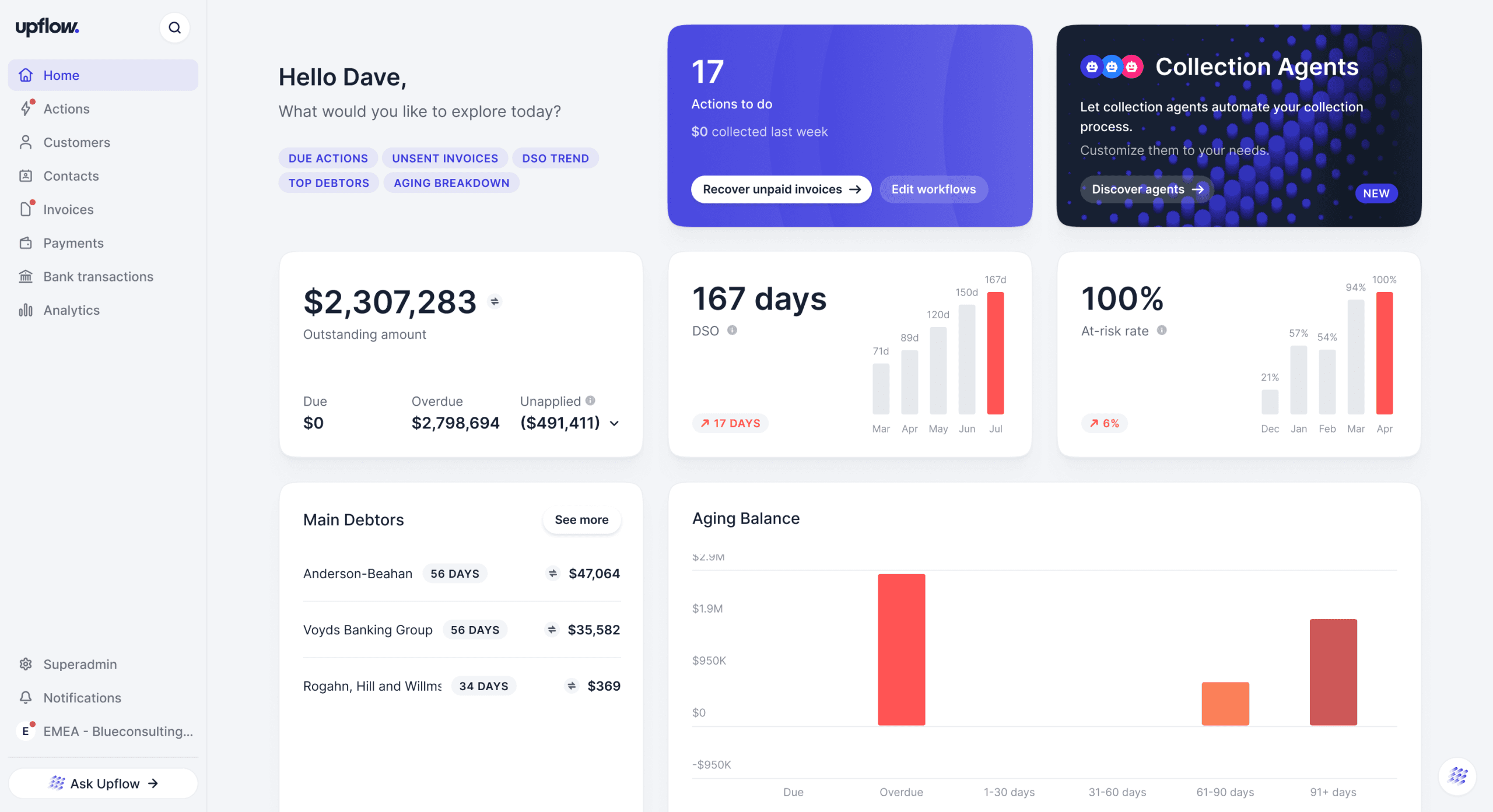
Upflow is the best accounts receivable (AR) software for B2B companies as it is the only one that combines collections automation, payments, and customer relationship management in one unified platform. Upflow pioneered Financial Relationship Management (FRM), an approach that treats collections as a customer-facing function, not a back-office task.
Rather than treating collections like a disconnected back-office task, Upflow was built from the ground up to elevate how teams approach AR. It’s grounded in a framework Upflow developed: The 5 Maturity Stages of Cash Collection.
These five stages represent the natural progression from basic visibility to strategic cash flow optimization. Most companies are at Stage 1 or 2, and don’t even realize better is even possible. Here’s how to identify where you are:
If you can’t answer, “What’s happening right now in my collections?”, you’re likely at Stage 1. You know cash flow matters, but you need visibility, not for its own sake, but to answer basic questions: What’s outstanding? Who owns what? Why am I not getting paid?
If you’re thinking about how best to prompt your customers to pay you, you’re at Stage 2. Most AR tools treat this as a simple automation problem: send reminders, escalate, repeat. But effective collections require understanding customer behavior, timing, and relationship dynamics. Upflow approaches Stage 2 as relationship management, not task automation.
If you want to build a world class finance operation: You need to progress through all the stages to reach predictable cash flow. That’s what makes financing possible and actually worth using. Upflow was built to get you there from foundational visibility all the way to optimized payment mix and AR financing.
For your team this means: A single workspace where every account, conversation, and payment status is visible in real time.
For your customers this means: A smoother experience with modern payment methods built into the flow.


Ron Wolff Kochavi
Director of Finance @ Walnut
Key Highlights:
- FRM platform combining collections, payments, and analytics in one unified system
- Conversational AI for instant answers on risk, forecasting, and performance
- Multi-channel collections (email, calls, letters, SMS) with unlimited team access
- Same-day payment activation with branded portal and custom domain support
- AI-native analytics with 15+ pre-built widgets and conversational queries
- Real-time ERP, CRM, and billing integrations with deep customization capabilities
- SOC 2 Type 2 certified with PCI Service Provider Level 1 compliant payment infrastructure
- Used by companies like Vercel, Productboard, Lattice and Front
Consider if: You’re a B2B company between $10M and $500M in revenue that wants to modernize collections without a lengthy implementation process, and needs finance, sales, and CS working from the same system.
Keep in mind: Best suited for companies that want all relevant teams working together on collections, not just the finance team alone.


Jamie Tinsley
Credit Control Manager @ Feefo
2. HighRadius

Best for: Finance teams managing high invoice volumes and complex processes globally.
Good fit for: Large enterprises looking for deep automation and AI-driven collections at scale.
HighRadius targets large enterprises with complex, high-volume AR operations that need comprehensive automation across the entire order-to-cash cycle. While it offers powerful AI tools and deep integrations with enterprise ERPs like SAP and Oracle, it’s often overwhelming for smaller teams and requires significant IT resources and time for implementation. It’s less suitable for mid-sized companies or those seeking quick deployment.
Key Highlights:
- Full-suite automation across collections, deductions, cash application, and credit
- AI-powered payments processing, risk scoring, and prioritization
- Modular platform with configurable features
- Enterprise-grade reporting and forecasting
- Strong integrations with SAP, Oracle, and Netsuite
- Streamlines the resolution of disputes and deductions through automation
- AI-powered credit risk management with global agency data
- Used by companies like Unilever, Adobe, and Danone
Consider if: You’re a very large enterprise (1,000+ employees) with a dedicated IT team, SAP or Oracle as your ERP and the runway for a 6-12 month implementation cycle.
Keep in mind: Setup typically requires significant IT resources and a lengthy onboarding period, making it impractical for most mid-sized teams or anyone needing quick deployment.
3. Bill (previously Bill.com)

Best for: Teams looking to automate basic payment workflows without a complex setup.
Good fit for: Small to mid-sized businesses looking for a simple, all-in-one AR and AP solution.
Bill serves small to mid-sized businesses that want a straightforward solution combining both accounts payable and accounts receivable. However, while it’s easy to setup and use, it lacks the sophisticated AR features and customer experiences that growing companies need. Its basic automation and limited customization options can become restrictive as businesses scale.
Key Highlights:
- Unified platform for managing both AP and AR process
- Automated invoicing, payment reminders, and recurring billing
- Built-in approval workflows and role-based permissions
- Offers mobile applications for iOS and Android devices
- Integration with QuickBooks, Xero, Netsuite, and Sage
- Maintains detailed audit trails and supports compliance with financial regulations
- Self-service portal for viewing invoices and making payments
- Used by companies like Qualtrics, Calendly, and Thumbtack
Consider if: You’re a small business (under $5M revenue) that needs a very simple way to manage both AP and AR in one place and doesn’t yet require advanced collections workflows.
Keep in mind: Bill is built for simplicity, not scale. Companies growing past early-stage will quickly hit the ceiling on automation depth, customisation, and customer experience.
4. Tesorio

Best for: Finance-led teams that want to align AR execution with broader financial goals.
Good Fit for: Mid-market and enterprise companies that need forecasting and AR automation in a single platform.
Tesorio appeals to finance teams that want to combine cash flow forecasting with collections automation in a single platform. While it offers sophisticated automation capabilities, teams should expect ERP sync delays and collaboration features that are more finance-focused than cross-functional.
Key Highlights:
- Cash flow forecasting based on synched AR data
- Predictive collections based on payment patterns and risk scoring
- Automated collections campaign with smart segmentation and personalized outreach
- Consolidated bank reporting for unified cash visibility
- ERP integrations with Netsuite, Sage Intacct, Quickbooks, and more
- Automated cash application to streamline payment matching
- Customer payment portal offering flexible, secure, and self-service payment options
- Used by companies like Seismic, Couchbase, and Veeva
Consider if: You’re a finance-only collection team that prioritizes cash flow forecasting over cross-functional collaboration, and you don’t need other team like sales or CS teams involved in collections at all.
Keep in mind: ERP sync delays mean your data is not real-time, and collections stays siloed within finance, limiting alignment with the rest of the business.
5. Invoiced (by Flywire)

Best for: Finance teams seeking to automate their entire AR process.
Good Fit for: Mid-sized companies looking to reduce manual work and improve cash flow.
Invoiced targets companies with complex billing needs, offering strong automation for subscription billing, flexible payment plans, and comprehensive invoicing capabilities. However, it’s primarily automation-focused rather than collaboration-oriented, which means that teams needing multi-user coordination and cross-functional workflows may find it lacking compared to platforms designed for modern team collaboration.
Key Highlights:
- End-to-end automation from invoicing to cash application
- Subscription billing and flexible payment plan support
- Branded self-service customer portal
- Custom workflow automation with drag-and-drop builder
- Integrates with Quickbooks, Netsuite, Xero, and more
- Real-time analytics and cash flow forecasting
- Multi-entity reporting with filters and aggregated views
- Used by companies like Tmobile, MassMutual, and Crisp Video
Consider if: You have complex subscription billing needs and your primary problem is billing automation and not cash collection efficiency.
Keep in mind: Invoiced is an automation-first platform. Teams that need sales, CS, and finance working from the same view will find it limiting, as it wasn’t built for cross-functional collections work.
6. Quadient AR (Yaypay)

Best for: Large finance teams managing high volumes of customer accounts.
Good Fit for: Large enterprises that prioritize process controls and auditability over ease of use.
Quadient AR serves large enterprises that need comprehensive order-to-cash automation with robust controls, dispute management, and detailed forecasting capabilities. While it offers powerful enterprise features and customization options, its interface feels dated and less intuitive compared to modern AR platforms, and its focus on structure and control can limit flexibility for faster-moving or smaller teams.
Key Highlights:
- Comprehensive automation across invoicing, collections, and cash application
- Customizable collection workflows with no-code interface
- Integrated customer payment portal for seamless transactions
- Real time-dashboards and 94% accurate cash flow forecasting
- Integrates with Netsuite, Microsoft Dynamics, Sage, and more
- Advanced dispute management with dedicated resolution workspace
- Analytics with AI-assisted insights to optimize collection strategies
- Used by companies like StackAdapt, WSAudiology, and Watermark
Consider if: You’re a large enterprise with a dedicated AR team that needs rigid process controls and detailed dispute management, and ease of use is secondary to you.
Keep in mind: Quadient is a better fit for teams that need strict process controls and detailed record-keeping, and can live with a clunkier UI experience to get them
7. Kolleno

Best for: Teams that want to centralize AR, payments, and credit management in one platform.
Good Fit for: Mid-sized and enterprise businesses that want to automate collections without juggling multiple tools.
Kolleno targets companies wanting a unified platform for AR, payments, and credit control with automated reminders and integrated task management. However, while it consolidates multiple functions, the initial setup can be time-intensive (especially when building workflows from scratch), and its reporting capabilities are limited with few built-in formats and minimal customization options for data analysis.
Key Highlights:
- Centralized AR, payments, credit workflows in one platform
- Automated reminders with personalized messaging
- Dispute management tools to track and resolve issues faster
- Customer risk scoring with external credit data and alerts
- Integrates with Netsuite, Quickbooks, Sage, and more
- Real-time collections dashboard and insights
- Task management to assign and track follow-ups
- Used by companies like 1password, DNA Payments, and Carbon 6
Consider if: You want to consolidate AR, payments, and credit into one platform and are willing to invest a long setup time to build out your workflows from scratch.
Keep in mind: Reporting is limited and the workflow builder requires significant configuration before you see value, which can slow down time to impact.
8. Chaser

Best for: Teams that want to automate invoice-follow ups without losing the personal touch.
Good Fit for: Small to mid-sized businesses seeking to automate AR without complex setups.
Chaser is designed for smaller businesses that want simple collections automation with multi-channel reminders and personalized customer communications. However, it has fairly limited reporting capabilities with minimal customization options and may not provide the depth of analytics or breadth of features that larger enterprises require.
Key Highlights:
- Multi-channel collections built for personalized outreach
- Auto-call and call logging features to streamline follow ups
- AI-powered recommended chasing times for optimized payment reminders
- Customer payment portal with real-time invoice visibility
- Integrates with Xero, Quickbooks, Sage, and more
- Chaser Pay allows customers to pay via Apple Pay, open banking, and credit cards
- Real-time credit checks and monitoring to reduce risk
- Used by companies like Bright Network, Air IT, and Pact Coffee
Consider if: You’re a very small business that just needs simple, automated invoice follow-ups.
Keep in mind: Reporting is limited with minimal customisation options, making it hard to track collection performance in depth.
9. Paddle

Best for: SaaS companies that need global payment infrastructure and tax compliance handled in one place.
Good Fit for: Software businesses selling internationally that want to offload VAT, GST, and sales tax compliance rather than manage it internally.
Paddle is a merchant of record platform built specifically for software companies. Rather than acting as a payment processor, Paddle becomes the legal seller of record for each transaction, which means it takes on tax collection, compliance, fraud protection, and chargeback management on your behalf. For SaaS founders selling in multiple countries who don’t want to deal with VAT filings across dozens of jurisdictions, that is a genuine time-saver.
Where Paddle falls short as an AR tool is everything that happens after payment. It handles the transaction infrastructure well, but it was not built around the collections problem. There is no collections workflow, no AR aging view, no customer outreach tooling, and no way to connect payment data to how your finance team manages outstanding invoices. For companies where the challenge is getting customers to pay invoices they have already received, rather than processing card payments at checkout, Paddle is the wrong category of tool.
Key highlights:
- Merchant of record model: handles global tax compliance across VAT, GST, and sales tax in 200+ countries
- Subscription billing and dunning with automated payment recovery
- Fraud protection and chargeback management included
- Revenue analytics through the ProfitWell integration
- Checkout, invoicing, and compliance bundled into one platform
- Pricing at 5% + $0.50 per transaction with no monthly fee on the standard plan
Consider if: You are a SaaS company whose primary need is global payment infrastructure and tax compliance, and your customers pay by card at checkout rather than on invoice terms.
Keep in mind: Paddle is a payment and billing platform, not an AR tool. It has no collections workflow, no AR aging, and no customer outreach capabilities. Teams dealing with outstanding B2B invoices and late payments need a different category of product.
10. Gaviti

Best for: Teams that want flexible AR automation tailored to their collections process.
Good Fit for: Mid-sized and enterprise businesses looking for modular features and deep workflow control.
Gaviti offers a modular AR platform that lets companies choose specific features they need (from cash application to dispute management) with deep configurability and ERP-agnostic integrations. However, its interface can feel dated and less intuitive than modern alternatives, reporting customization is limited, and teams often need significant onboarding support to fully utilize its capabilities, making it less ideal for companies wanting quick deployment.
Key Highlights:
- Modular platform tailored to your collections needs
- Automated workflows with smart reminders and task tracking
- Automated payment matching using remittance data
- Dispute and deduction resolution with customization workflows
- ERP-agnostic platform with seamless integrations across all major and custom systems
- Credit management tools with real-time monitoring
- Gaviti AI optimizes collections with smart, real-time decision making
- Used by companies like TravelPerk, Vernovis, and Wochit
Consider if: You have a highly specific collections process that off-the-shelf platforms don’t accommodate and you have the internal resources to handle a longer, more hands-on implementation.
Keep in mind: The modular approach means significant onboarding investment before the platform delivers value. Teams wanting fast time-to-impact will find it very slow.

Why Financial Relationship Management Is the Real Differentiator
Most AR tools focus on one thing: helping finance teams chase overdue invoices more efficiently. Automation, reminders, and reporting all matter, but they’re no longer enough on their own.
What separates modern AR leaders from the rest is how well they integrate collections into the customer relationship.
Upflow is the only platform on this list built specifically around that idea. Instead of treating collections as a back-office task to be minimized, it approaches AR as a customer-facing function that directly impacts retention, expansion, and long-term revenue.
This approach is called Financial Relationship Management (FRM).
When AR is managed through an FRM lens, a few important things change:
Teams stop working in silos.
Finance, sales, and customer success operate from the same source of truth and coordinate outreach based on shared context, not disconnected spreadsheets.
According to a 2024 Forrester report, firms with high levels of alignment across customer-facing functions report 2.4 times higher revenue growth and twice the profitability growth compared to those without such alignment.

Customers get a better experience.
With Upflow, payment communication feels relevant and timely, consistent with the rest of the customer journey rather than a jarring reminder that someone owes you money.
According to McKinsey, companies that lead in personalization generate 40% more revenue from those efforts than average performers. Additionally, 71% of consumers expect personalized interactions, and 76% get frustrated when they don’t receive them.
You collect faster without burning bridges.
By segmenting customers intelligently, teams can apply automation where it makes sense while preserving white-glove treatment for strategic accounts.
According to Dun & Bradstreet’s Q4 2024 Accounts Receivable Industry Report, 16 out of 210 industries have over 10% of their aging receivables that are more than 91 days past due.
The result isn’t just better DSO, though that comes too. The real impact shows up in stronger customer relationships, better internal alignment, and a finance function that actively supports growth rather than reacting to late payments.
Many of the tools on this list do AR well. Upflow is the only one built to turn collections into a competitive advantage.
Frequently Asked Questions
Can’t find what you’re looking for?
Ask AI


An Accounts Receivable (AR) tool helps businesses stay on top of unpaid invoices. It handles follow-ups, tracks payment status, and reduces manual effort across the collections process.
AR automation focuses on efficiency and streamlining tasks. Financial Relationship Management (FRM) goes further by putting the customer experience at the center of how you collect.
Yes. Many platforms have branded portals, two-way messaging, and payment flexibility. These features make collections feel like a part of your brand, not just a billing function.
If you’re a growing business, Upflow is the strongest choice. It’s built to handle the complexity that comes with scale while keeping the customer experience intact. For very small teams that just need simple invoice follow-ups, Chaser and Bill maybe good starting points.
Larger companies need a platform that handles complexity without sacrificing the customer experience. Upflow is built for exactly that, combining native ERP integrations, cross team collaboration, and AI-powered analytics in one system. For companies with very high invoice volumes or SAP/Oracle dependencies, HighRadius and Quadient can be worth evaluating, though both require significantly more implementation time and investment.
That’s a good start, but billing systems don’t handle collections well. AR tools step in where billing ends and help you follow up, prioritize accounts, and get paid faster.
That depends on your starting point. Teams moving from spreadsheets or disconnected tools often see improvements in cash flow and DSO within a few billing cycles.
Yes. Upflow offers a free Discover plan that’s perfect for benchmarking for current AR process. Chaser and Kolleno also provide free trials or limited free versions, which are great for testing before committing.